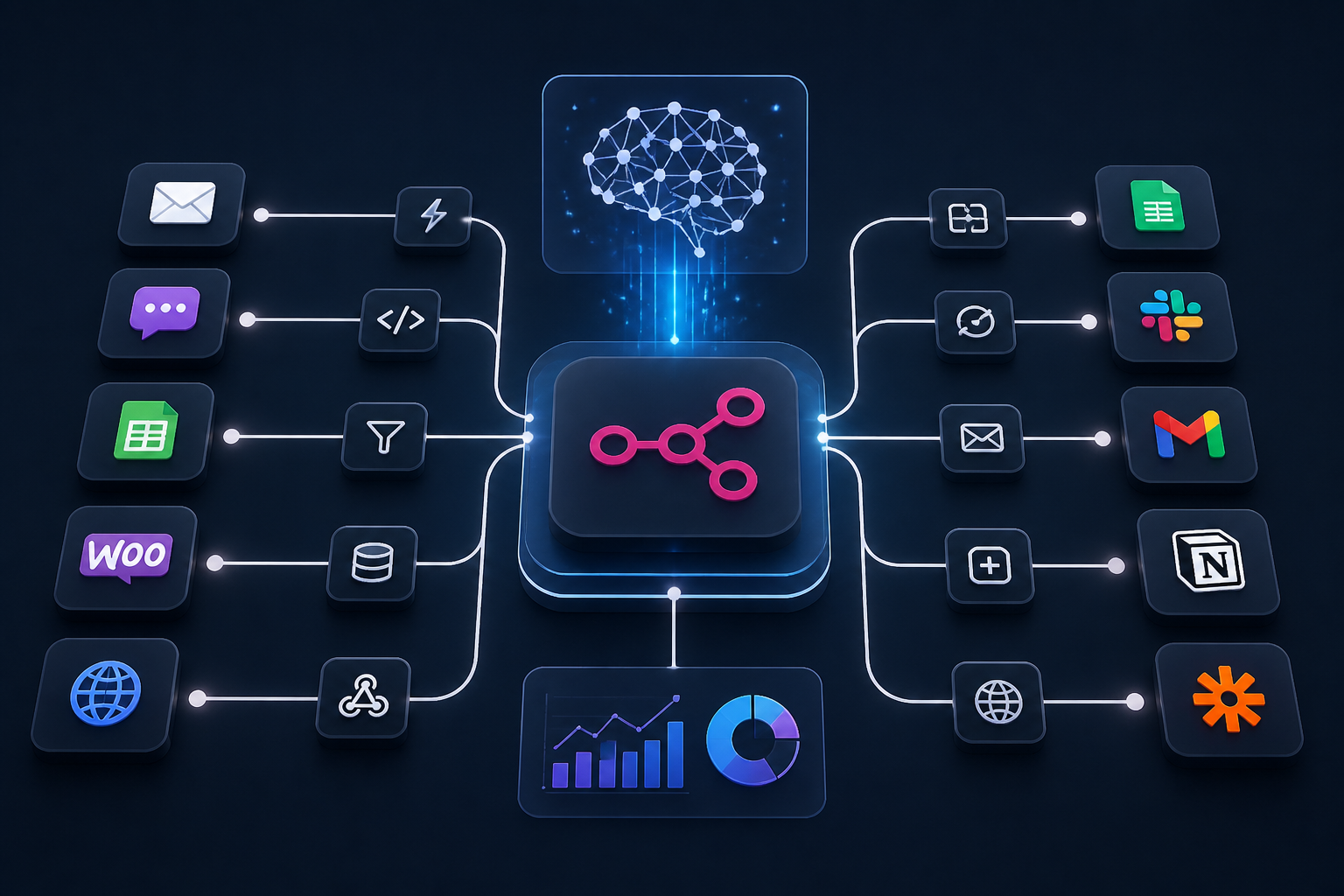
Modern enterprise operations demand resilient, scalable, and adaptable integration architectures. While basic script-based triggers can handle linear tasks, complex business environments require visual orchestration platforms that can inspect payloads, handle asynchronous errors, and maintain state across multiple third-party APIs. n8n workflow automation ideas span multiple operational domains, offering robust node-based execution models that bridge traditional webhooks with modern artificial intelligence engines.
This comprehensive architectural guide explores 25 high-impact production workflows designed for scalable implementation. Whether you are orchestrating multi-agent AI loops, synchronizing e-commerce data streams, or managing secure internal operations, understanding the foundational mechanics, failure modes, and optimization strategies of advanced n8n pipelines is critical for maintaining long-term system stability.
Foundations of Advanced n8n Workflow Architecture
Before deploying complex automation topologies, engineering teams must understand the core structural components that govern execution performance. Unlike traditional serverless functions that spin up single-purpose runtimes, n8n relies on a structured node execution engine that passes JSON payloads between triggers, action nodes, and conditional routers.
In a self-hosted environment, execution data is written directly to an underlying database (such as PostgreSQL), allowing for granular execution history tracking, payload inspection, and manual retry mechanisms. When designing enterprise-grade workflows, architects must balance synchronous webhook responsiveness with asynchronous queue processing using Redis workers. This separation prevents blocking operations from starving system resources during traffic spikes.
For official documentation and technical specifications regarding node development and execution scaling, consult the n8n documentation.
1. Autonomous Multi-Agent Business Intelligence Pipeline
Business intelligence (BI) operations frequently suffer from data fragmentation across relational databases, analytical data warehouses, and unstructured communication channels. An autonomous BI pipeline coordinates multiple AI agents to ingest, clean, and synthesize operational metrics into actionable executive summaries.
The workflow triggers via a scheduled Cron node or an explicit webhook ping from an analytics database. The incoming payload containing raw query results is passed to an HTTP Request node that queries large language models via the OpenAI & ChatGPT Docs specification or an equivalent LLM provider. An intermediate code node parses the raw text response, formats structural markdown tables, and routes the final output directly to internal messaging channels or secure dashboard webhooks.
Implementation Considerations
- Token Limits: Large analytical datasets must be chunked or pre-aggregated in database queries before being injected into prompt contexts.
- Execution Timeouts: Complex AI reasoning loops can exceed standard webhook timeout limits; configure asynchronous execution queues for long-running analytical tasks.
- Data Sanitization: Ensure PII (Personally Identifiable Information) is scrubbed from payloads prior to external API transmission.
2. Real-Time WooCommerce Order Processing & Inventory Synchronization
E-commerce fulfillment requires instantaneous inventory checks and transactional record-keeping across disparate accounting and warehouse management systems. A robust WooCommerce integration pipeline intercepts incoming checkout webhooks to validate customer data, verify stock levels, and trigger downstream fulfillment workflows.
When an order is placed, WooCommerce fires a secure webhook intercepted by an n8n Webhook node. The workflow immediately validates the cryptographic signature of the payload. It then branches into parallel execution paths: one branch updates the local enterprise resource planning (ERP) system, while another dispatches confirmation emails through transactional email providers. For deep architectural insights into e-commerce extensions, review the WooCommerce Developer Docs.
3. Automated Customer Support Ticket Triage & Sentiment Analysis
Support desk queues often bottleneck due to manual categorization and priority assignment. An automated triage workflow ingests incoming support emails or live chat transcripts, evaluates customer sentiment, extracts core technical intent, and routes tickets to specialized internal queues.
The pipeline utilizes an incoming email trigger, passes the message body through an AI node configured with a classification prompt, and applies conditional logic to assign priority tags. High-urgency tickets marked with negative sentiment trigger immediate SMS or high-priority chat alerts, while routine inquiries are automatically logged into the primary CRM platform.
4. Cross-Platform Lead Enrichment and Scoring Engine
Marketing qualification requires combining inbound form submissions with external firmographic and technographic data providers. This workflow intercepts lead capture events from landing pages, queries external enrichment APIs, calculates a composite lead score based on predefined business rules, and updates the central marketing automation database.
When designing lead enrichment pipelines, architects must implement strict rate-limiting error handlers to gracefully manage third-party API throttling without dropping customer acquisition data.
5. Automated Content Generation, SEO Auditing, and Publishing
Publishing digital content at scale requires consistent optimization and structural validation. An advanced publishing pipeline generates draft articles via LLM integrations, runs automated SEO grammar and keyword checks, and schedules final markdown payloads directly to content management systems.
For developers building custom publishing integrations, understanding native API endpoints via the WordPress Developers repository ensures seamless authentication and payload formatting.
6. Intelligent Invoice Extraction and Financial Reconciliation
Manual data entry of vendor invoices introduces human error and administrative delay. This workflow monitors dedicated inbound email addresses for PDF attachments, passes documents through optical character recognition (OCR) and vision-enabled AI nodes, extracts line-item totals, and posts validated records directly into accounting software.
When integrating financial systems, maintaining strict audit logs within the n8n execution history provides necessary compliance tracking for internal accounting reviews.
7. Automated Social Media Content Distribution & Performance Tracking
Managing multi-channel brand presence requires synchronized publishing across professional networks, microblogging platforms, and visual media repositories. This workflow schedules approved assets from a centralized project management database, transforms caption lengths to fit platform-specific constraints, and aggregates engagement metrics into a weekly reporting dashboard.
8. Server Infrastructure Health Monitoring and Incident Response
Downtime mitigation relies on rapid anomaly detection and automated initial remediation. This workflow polls critical server health metrics or ingests webhook alerts from cloud infrastructure providers, evaluates error thresholds, and triggers automated scaling actions or paging alerts to on-call engineering teams.
9. Automated Database Migration and Schema Validation Pipelines
Database synchronization across staging and production environments requires strict schema verification to prevent runtime exceptions. This workflow automates SQL dump execution, validates table constraints, and executes synthetic smoke tests against staging endpoints before notifying engineering leads of successful deployment status.
10. Client Onboarding and Provisioning Orchestration
New client acquisition triggers a cascading series of administrative tasks, including workspace creation, license allocation, and welcome communication dispatch. This workflow orchestrates account provisioning across multiple SaaS platforms, verifying successful API responses at each step before marking the onboarding record as complete.
11. Automated Bug Report Classification and Engineering Assignment
Unstructured user bug reports submitted through feedback widgets often lack necessary reproduction details. This workflow intercepts incoming bug submissions, uses AI agents to extract browser metadata, operating system details, and stack traces, and formats standardized issue tickets for core engineering sprints.
12. Dynamic Pricing Engine and Competitor Price Scraping
E-commerce competitiveness depends on agile pricing adjustments. This workflow scheduled execution scrapes designated competitor product pages, normalizes pricing structures, calculates optimal margin thresholds, and updates storefront product pricing via secure administrative APIs.
13. Automated Employee Offboarding and Access Revocation
Security compliance mandates immediate revocation of digital credentials upon employee departure. This workflow listens for HRIS status change events, systematically revokes access across cloud identity providers, enterprise chat tools, and code repositories, and generates a cryptographic audit report for security teams.
14. Supply Chain Freight Tracking and Status Notification
Logistics visibility prevents customer service friction during shipping delays. This workflow polls third-party carrier APIs for milestone updates, calculates estimated delivery time adjustments, and automatically dispatches contextual notification emails to waiting recipients.
15. Automated Compliance Auditing and PII Detection Scans
Regulatory frameworks such as GDPR and CCPA require continuous monitoring of stored customer data. This workflow periodically scans internal document repositories and database fields using pattern-matching regex and AI classifiers to identify exposed PII, immediately alerting security administrators to potential compliance breaches.
16. Multi-Language Content Localization and Translation Pipeline
Global digital expansion requires localized copy adaptation that preserves brand tone across linguistic markets. This workflow ingests master English content payloads, segments text blocks by semantic context, passes strings to specialized translation models, and structures localized output files for deployment.
17. Automated Video Transscription and Chapter Summary Generation
Video content accessibility requires accurate closed captions and descriptive chapter indexing. This workflow accepts raw video asset URLs, routes audio tracks through speech-to-text transcription APIs, summarizes core topics using LLMs, and outputs time-stamped metadata files.
18. Automated Git Repository Release Notes & Changelog Generation
Maintaining clear software release notes is vital for user adoption and developer transparency. This workflow aggregates merged pull request titles, commit messages, and issue labels between version tags, synthesizes a human-readable changelog using AI text generation, and publishes updates to documentation portals.
19. Dynamic PDF Report Generation and Secure Distribution
Generating customized executive reports on demand streamlines client relationship management. This workflow compiles data from multiple relational tables, populates HTML template structures, renders high-fidelity PDF documents, and securely delivers files via encrypted email links.
20. Automated Domain and SSL Certificate Expiration Monitoring
Unexpected SSL certificate expirations cause severe service outages and brand erosion. This workflow queries domain registrar and certificate authority endpoints daily, calculates remaining validity windows, and triggers escalating alerts when thresholds drop below critical operational limits.
21. Automated Podcast Episode Syndication and RSS Distribution
Media distribution requires synchronizing audio files, show notes, and transcript assets across multiple podcast hosting networks and directory feeds. This workflow parses incoming audio bucket uploads, updates XML RSS manifests, and pings directory update endpoints.
22. Interactive Chatbot Fallback and Human Handoff Orchestration
Automated conversational agents occasionally encounter complex user queries outside their training scope. This workflow monitors chat interaction confidence scores, detects sentiment degradation or explicit human agent requests, and seamlessly transfers conversation context to live support queues.
23. Automated Affiliate Commission Calculation and Payout Audit
Managing partner ecosystems requires precise tracking of referral conversions and payout calculations. This workflow aggregates clickstream data, verifies successful transaction statuses, calculates tiered commission splits, and generates preliminary payout ledgers for financial review.
24. Real-Time Brand Mention Tracking and Sentiment Aggregation
Public relations monitoring requires continuous scanning of social channels, news feeds, and review sites. This workflow ingests real-time search API streams, evaluates brand mention sentiment, and populates centralized internal dashboards for marketing leadership.
25. Automated Disaster Recovery Backup Verification and Integrity Testing
Routine backup generation is insufficient without rigorous restoration testing. This workflow automates the nightly extraction of database snapshots, spins up isolated test containers, executes validation queries to verify data integrity, and reports operational status to infrastructure leads.
Advanced Error Handling and Resilience Strategies
Deploying production workflows requires sophisticated error management beyond basic execution logging. When building high-impact automation pipelines within n8n, engineers must implement explicit error-handling paths using Error Trigger nodes.
An effective resilience strategy involves:
- Exponential Backoff: Configuring HTTP Request nodes to retry failed API calls with increasing time intervals to handle transient network partitions.
- Dead Letter Queues (DLQ): Routing permanently failed payloads to secondary storage tables for manual inspection rather than allowing silent execution drops.
- Idempotency Design: Ensuring webhook handlers can process duplicate delivery events without duplicating database records or financial transactions.
For organizations scaling automation across multiple departments, exploring broader operational strategies in business process automation frameworks provides valuable contextual understanding.
Security, Authentication, and Credential Management
Securing sensitive credentials across automated workflows is a paramount engineering requirement. Storing API tokens, database passwords, and cryptographic keys as plain text within node parameters introduces severe security vulnerabilities.
Best practices for n8n credential management include:
- Leveraging environment variables and encrypted credential stores provided by the n8n application core.
- Restricting webhook execution endpoints using HMAC signature verification to prevent unauthorized payload injection.
- Enforcing principle of least privilege access when generating API keys for third-party integrations.
Additionally, understanding how to structure scalable automation architectures is essential for long-term maintainability. For deeper insights into designing resilient enterprise architectures, review our guide on AI agent workflow automation strategies.
Frequently Asked Questions
What is the best way to handle large payloads in n8n workflows?
When processing large files or extensive datasets, avoid passing raw binary data directly through standard JSON execution nodes. Instead, stream binary data to cloud object storage buckets (such as Amazon S3 or compatible equivalents) and pass lightweight reference URLs through the workflow execution chain.
How can I scale n8n for high-throughput enterprise environments?
To scale n8n beyond single-instance limitations, deploy the platform in Queue Mode using Redis as the message broker and multiple worker containers managed via container orchestration platforms like Kubernetes. This decouples webhook reception from heavy task execution.
Are self-hosted n8n instances secure for handling sensitive customer data?
Yes, self-hosted n8n instances offer superior data sovereignty compared to public cloud alternatives, provided the underlying server infrastructure, database connections, and environment variables are properly hardened, encrypted, and isolated within secure virtual private clouds (VPCs).
Conclusion
Designing and deploying high-impact production workflows requires careful balance between rapid integration agility and rigorous architectural discipline. By leveraging advanced error-handling patterns, robust credential management, and scalable execution queues, engineering teams can unlock the full potential of workflow automation. Whether you are orchestrating complex multi-agent intelligence loops or streamlining transactional e-commerce pipelines, maintaining focus on security, resilience, and data integrity ensures sustainable operational success across modern digital enterprises.
