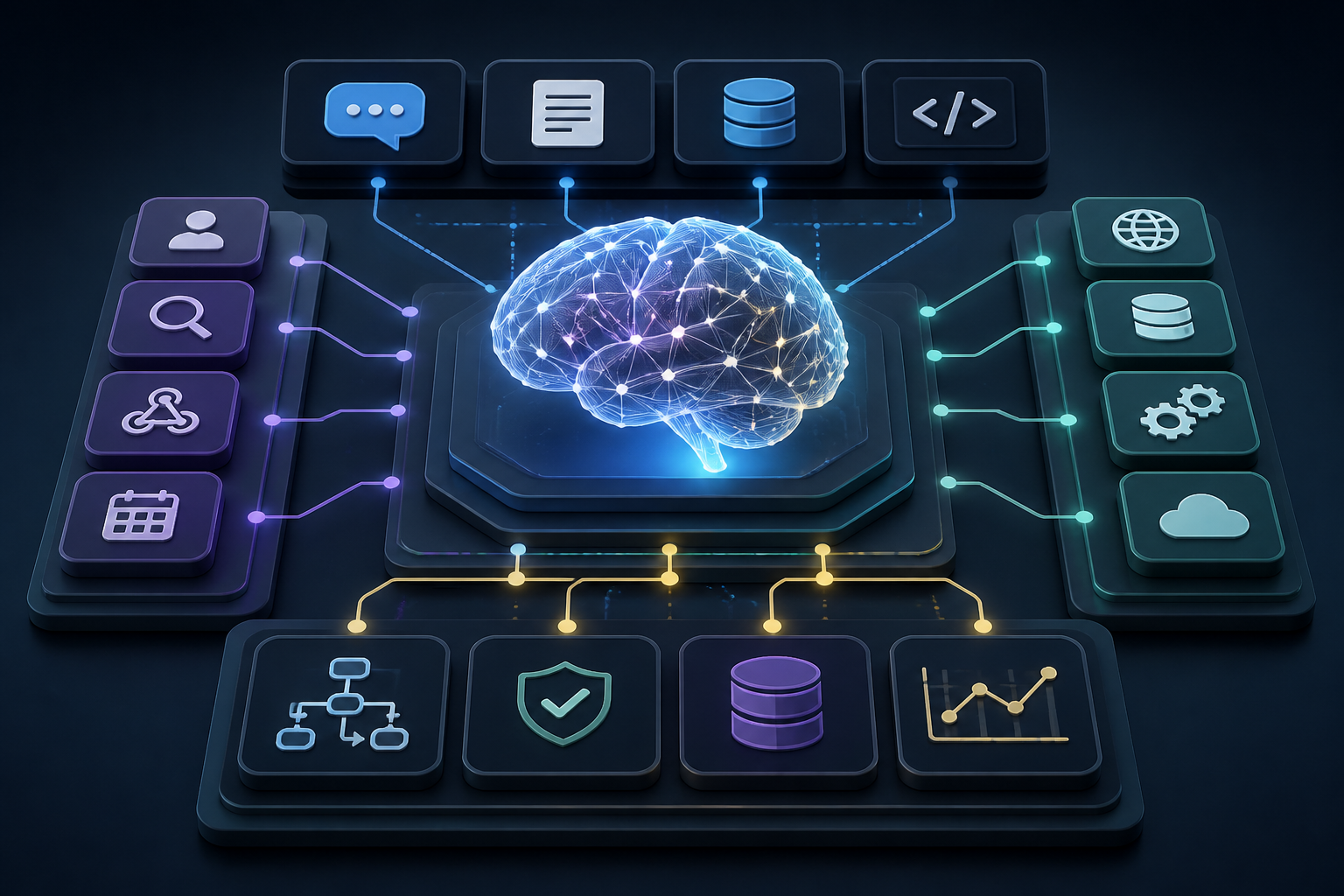
Custom AI agent development represents a fundamental paradigm shift in modern software engineering. Where traditional software relies on explicit, deterministic control flows written in code, an AI agent leverages Large Language Models (LLMs) as cognitive engines capable of dynamic planning, reasoning, tool selection, and autonomous execution. However, moving beyond simple demonstration scripts to production-ready enterprise custom AI agents requires deep technical architecture, state management, safety guardrails, and robust integration patterns.
Off-the-shelf chatbot wrappers and generic AI assistants frequently fail when confronted with complex business environments. Enterprise digital workflows demand bespoke contextual understanding, low-latency execution, real-time database transactions, high operational reliability, and granular authorization controls. Developing a custom AI agent allows software teams to embed domain-specific logic, enforce strict tool signatures, integrate dual-memory architectures, and guarantee deterministic state persistence across multi-turn asynchronous workflows.
This comprehensive guide provides technical architects, systems engineers, and automation developers with an end-to-end blueprint for custom AI agent development. We explore core architectural paradigms, compare leading orchestration frameworks, implement typed tool-calling interfaces, design persistent state structures, construct multi-agent collaborative networks, and establish evaluation pipelines to deploy production-ready autonomous systems.
Executive Summary & Architecture Matrix
Building a custom AI agent requires a clear evaluation of architectural requirements. The matrix below outlines the critical decisions developers face when selecting components across the agent technology stack.
| Architectural Component | Standard Approach | Custom Agent Approach | Primary Engineering Benefit |
|---|---|---|---|
| Control Flow | Linear, static chains (e.g., rigid LLM pipelines) | Dynamic State Graphs & Directed Acyclic Graphs (DAGs) | Adaptive decision paths, cycle support, dynamic loops, and recovery |
| Tool Execution | Hardcoded prompt parameters or manual API callers | Typed JSON-Schema function calling with Pydantic validation | Deterministic execution, runtime schema validation, safe API parameters |
| Memory Systems | Stateless prompt history concatenation | Dual Memory (Short-Term Working Memory + Hybrid Vector/KG Long-Term) | Cross-session state persistence, sub-context retrieval, bounded context usage |
| Governance | Post-hoc LLM text filtering | Deterministic Guardrail Interceptors & Human-in-the-Loop (HITL) | Zero-trust action boundaries, PII masking, transactional approval gates |
| Observability | Simple request/response logging | Distributed Trajectory Tracing (OpenInference / OpenTelemetry) | Step-by-step latency tracking, tool execution audits, token cost analysis |
Understanding Custom AI Agents: Architectural Foundations
To design an enterprise-grade agent, developers must understand the foundational building blocks and structural taxonomy that govern autonomous AI systems.
The 5 Core Parts of an AI Agent
Every autonomous agent, regardless of complexity, consists of five core functional systems working in concert:
- Perception & Input System: Ingests structured and unstructured user messages, event triggers, webhook payloads, and environmental telemetry. Converts dynamic inputs into normalized internal states.
- Cognitive Engine (LLM Core): Processes current state context, user prompts, system instructions, and dynamic memory. Functions as the core reasoning mechanism that plans next steps and formulates outputs or tool requests.
- Planning & Reasoning Engine: Deconstructs macro objectives into micro-tasks using structured reasoning frameworks such as ReAct (Reason + Act), Plan-and-Solve, or Reflection loops. Generates execution graphs dynamically.
- Memory Subsystem: Manages transient execution data (short-term execution state) and persistent domain knowledge (long-term retrieval augmented memory). Prevents context-window bloat and preserves historical state.
- Action System (Tool Execution Bridge): Translates model-generated tool calls into concrete computational side-effects—invoking REST endpoints, running SQL queries, issuing database mutations, or calling external SDKs.
The 7 Structural Types of AI Agents
In custom AI agent development, architectural complexity scales according to environmental feedback requirements and environmental complexity. Agents generally fall into seven structural categories:
- Simple Reflex Agents: Act purely on immediate pre-defined rules or direct mapping from current perception to immediate action, ignoring event history.
- Model-Based Reflex Agents: Maintain internal state representations of unobserved environmental elements, allowing them to make decisions based on changing past context.
- Goal-Based Agents: Combine state tracking with explicit goal directives, evaluating potential future trajectories to select actions that achieve specific states.
- Utility-Based Agents: Evaluate multiple paths to a goal using complex utility functions, optimizing for variables such as cost, speed, safety, or resource efficiency.
- Learning Agents: Incorporate feedback mechanisms (such as reinforcement learning or automated preference optimization) to iteratively refine decision thresholds based on action outcomes.
- Multi-Agent Collaborative Systems: Distributed systems where specialized agents interact via message-passing interfaces, delegating tasks according to dynamic sub-agent specializations.
- Hierarchical Orchestrator Agents: Top-level supervisor systems that control nested operational agents, maintaining global governance while worker agents execute granular sub-tasks.
Prerequisites & Technology Stack Selection
Selecting the optimal tech stack dictates the stability, velocity, and maintainability of custom AI agent development. Modern enterprise stacks decouple orchestration, vector storage, foundation models, and telemetry.
Orchestration Framework Comparison
Choosing an orchestration framework involves balancing developer abstraction against low-level control. The major modern options include:
- LangGraph (Python/TypeScript): Provides fine-grained cyclical state graph control, native checkpointing, state persistence, and explicit Human-in-the-Loop flow control. Ideal for complex production agents requiring determinism.
- CrewAI: Offers role-based, multi-agent abstractions built on top of high-level task definitions. Excellent for rapid prototyping of agent teams and structured task delegation.
- AutoGen (Microsoft): A framework focused on multi-agent conversation patterns, asynchronous messaging, and flexible agent customization. Strong in automated multi-agent problem-solving.
- LlamaIndex Workflows: Event-driven framework tailored around advanced document processing, context augmentation, and knowledge retrieval pipelines.
- Custom Low-Code Engines (n8n Custom Nodes): Combines deterministic node execution with embedded AI agent nodes, allowing developer-built JavaScript/TypeScript nodes to expose APIs directly to agent workflows.
Foundation Models & Infrastructure Stack
A production agent stack usually incorporates several supporting services:
- Inference Layer: OpenAI API (GPT-4o, O3-Mini), Anthropic Claude (Claude 3.5 Sonnet / Haiku for tool calling and complex reasoning), or self-hosted open models (Llama-3, Qwen-2.5) via vLLM or Ollama.
- Vector Databases: Qdrant, Pinecone, or pgvector for fast hybrid dense/sparse semantic retrieval.
- State & Message Queue: Redis or PostgreSQL for short-term graph state retention, session storage, and distributed pub/sub.
- Observability Tracing: LangSmith, Phoenix (Arize), or OpenInference protocols exported to OpenTelemetry collectors.
Phase 1: Designing the Agent Cognitive Architecture
Before writing agent loops, developers must establish explicit dynamic state management structures and cognitive decision patterns.
ReAct vs. Plan-and-Solve vs. Reflection Patterns
Different reasoning strategies alter how the cognitive engine processes information and uses computational resources:
1. ReAct (Reasoning + Acting): The model interleave thoughts, actions, and observations in a continuous single-step feedback loop. While effective for short operations, simple ReAct loops can drift into execution loops or lose historical state on complex multi-step problems.
2. Plan-and-Solve: The model generates a comprehensive task list prior to execution, then systematically processes each sub-task sequentially. This reduces overall LLM API calls and stabilizes long-horizon tasks.
3. Reflection and Critic Loops: An execution agent generates a draft or carries out an action, followed by a critic agent validating the output against strict schema or acceptance criteria. If validation fails, constructive critique feeds back into the execution loop for auto-correction.
Defining Explicit State Graphs
Production AI systems avoid unstructured loops by managing execution context via state machines. Modern execution engines represent agent loops as directed graphs containing typed state schemas, nodes (executable functions), and conditional edges (decision branches based on state outcomes).
Phase 2: Building Custom Agent Tools & Function Calling Interfaces
An agent without functional tools is merely an isolated conversational model. Tools provide side-effect capabilities, enabling the agent to execute actions on databases, web APIs, and third-party SaaS infrastructure.
JSON Schema & Strict Parameter Validation
To ensure high reliability, tool schemas must enforce strict validation rules using static typing frameworks such as Pydantic in Python or Zod in TypeScript. The LLM must be constrained to output strictly valid tool call parameters matching these JSON schemas.
Python Implementation: Creating a Production-Grade Custom Tool Interface
Below is a production pattern for defining a custom database-lookup tool using Python, Pydantic, and LangGraph abstractions, complete with error isolation and standard error handling.
from typing import Type, Optional
from pydantic import BaseModel, Field
from langchain_core.tools import BaseTool
import requests

class InventoryCheckInput(BaseModel):
    sku: str = Field(..., description="The unique Product Stock Keeping Unit (SKU) identifier, formatted as SKU-XXXX.")
    warehouse_id: str = Field(default="main_wh", description="The regional warehouse identifier to query.")

class InventoryCheckTool(BaseTool):
    name: str = "check_warehouse_inventory"
    description: str = "Queries internal ERP to retrieve real-time inventory count and physical bin allocations for a SKU."
    args_schema: Type[BaseModel] = InventoryCheckInput

    api_endpoint: str
    auth_token: str

    def _run(self, sku: str, warehouse_id: str = "main_wh") -> str:
        """Executes synchronous inventory call with strict runtime error handling."""
        headers = {"Authorization": f"Bearer {self.auth_token}", "Content-Type": "application/json"}
        payload = {"sku": sku, "warehouse": warehouse_id}

        try:
            response = requests.post(f"{self.api_endpoint}/v1/inventory/query", json=payload, headers=headers, timeout=5)
            response.raise_for_status()
            data = response.json()

            stock_level = data.get("available_stock", 0)
            bin_location = data.get("bin_location", "Unknown")

            return f"SKU {sku} in Warehouse '{warehouse_id}': {stock_level} units available at Location {bin_location}."

        except requests.exceptions.Timeout:
            return f"Tool Execution Failure: Connection to inventory API timed out for SKU {sku}. Please try again or flag for human review."
        except requests.exceptions.HTTPError as e:
            return f"Tool Execution Failure: ERP API returned HTTP error status {e.response.status_code}. Details: {e.response.text}"
        except Exception as e:
            return f"Tool Execution Failure: An unexpected error occurred while executing check_warehouse_inventory: {str(e)}"
Defensive Schema Design Principles
- Explicit Descriptions: Write clear parameter descriptions indicating formats, valid regex patterns, and allowed values. LLMs use parameter descriptions to format inputs correctly.
- Sanitized Output Formatting: Return structured text or serialized JSON responses directly to the cognitive core. Avoid returning unhandled stack traces or large payloads that consume token budgets unnecessarily.
- Deterministic Fallback Strategies: If a tool fails three consecutive times due to bad parameter formatting, return a standardized failure message instructing the cognitive engine to halt or route execution to a fallback path.
Phase 3: State Management & Dual Memory Systems
Managing execution state across multi-turn sessions requires a dual-memory system that mirrors cognitive architectures: transient short-term execution state and persistent long-term knowledge access.
1. Short-Term Working Memory (Execution Context)
Short-term memory preserves immediate context throughout an active execution lifecycle. It keeps track of user intent, execution history, intermediate tool outcomes, and internal scratchpads. Developers must implement context-window management tactics to avoid exceeding model context boundaries:
- Sliding Window Truncation: Drops older raw interaction logs while retaining foundational instruction prompts and system state parameters.
- Summarization Pruning: Automatically condenses early tool calls and dialogue turns into an executive summary node when token context thresholds exceed limits (e.g., 75% of context window).
2. Long-Term Retrieval Memory (Episodic & Semantic)
Long-term memory enables agents to recall historical operational parameters, prior user interactions, and static corporate knowledge across multi-session horizons. This requires hybrid retrieval architectures combining dense vector semantic embeddings with sparse keyword search (BM25) and document filtering.
Implementing Stateful Memory Summarization in Python
The following example demonstrates how to implement automatic short-term context summarization within a persistent state structure using LangGraph.
from typing import Annotated, Sequence, TypedDict
from langchain_core.messages import BaseMessage, SystemMessage, HumanMessage, AIMessage, RemoveMessage
from langchain_anthropic import ChatAnthropic
from langgraph.graph import StateGraph, START, END
from langgraph.graph.message import add_messages

class AgentState(TypedDict):
    messages: Annotated[Sequence[BaseMessage], add_messages]
    summary: str

llm = ChatAnthropic(model="claude-3-5-sonnet-20241022", temperature=0)

def summarize_conversation_node(state: AgentState):
    """Summarizes legacy context when chat history grows beyond threshold."""
    summary = state.get("summary", "")
    messages = state["messages"]

    if len(messages) > 6:
        if summary:
            summary_prompt = (f"Existing conversation summary: {summary}\
\
"
                              "Extend the summary by incorporating the newest interaction context above:")
        else:
            summary_prompt = "Create a concise summary of the core user requests and intermediate outputs above:"

        summary_response = llm.invoke(messages + [HumanMessage(content=summary_prompt)])
        new_summary = summary_response.content

        # Retain only the most recent two messages and issue deletion operations for legacy nodes
        delete_messages = [RemoveMessage(id=m.id) for m in messages[:-2]]
        return {"summary": new_summary, "messages": delete_messages}

    return {}
Phase 4: Implementing Multi-Agent Orchestrations & Collaboration
Single-agent architectures often degrade in performance as task responsibility expands. Delegating complex domain requirements into a network of specialized, modular agents improves overall system reliability, code maintainability, and diagnostic clarity.
Primary Multi-Agent Topology Configurations
Architects generally select from three primary multi-agent communication patterns based on task requirements:
1. Router-Worker Architecture: A central router agent classifies incoming tasks and passes control entirely to a downstream domain-specific worker. The worker handles execution and returns the final answer directly to the requester.
2. Hierarchical Manager-Worker Architecture: A supervisor node controls sub-agent execution, orchestrating step-by-step handoffs, inspecting work products, and orchestrating execution loops until strict completion criteria are met.
3. Debating/Peer Verification Systems: Parallel independent agents process the same problem and submit outputs to a evaluation agent. The evaluator compares discrepancies, flags hallucination patterns, and synthesizes a verified response.
Building a Hierarchical Multi-Agent Graph
Below is a working implementation of a Supervisor-Worker agent flow configured with explicit handoff logic using LangGraph.
from typing import Literal, TypedDict, Annotated, Sequence
from pydantic import BaseModel
from langchain_core.messages import BaseMessage, HumanMessage
from langchain_openai import ChatOpenAI
from langgraph.graph import StateGraph, START, END
from langgraph.graph.message import add_messages

# Define Router Schema
class RouteResponse(BaseModel):
    next_node: Literal["database_specialist", "support_writer", "FINISH"]
    reasoning: str

class MultiAgentState(TypedDict):
    messages: Annotated[Sequence[BaseMessage], add_messages]
    next_step: str

llm = ChatOpenAI(model="gpt-4o", temperature=0)

def supervisor_node(state: MultiAgentState):
    """Evaluates current conversation state and routes to appropriate specialist node."""
    messages = state["messages"]
    system_prompt = SystemMessage(content=(
        "You are an enterprise support supervisor orchestrating task delegation.\
"
        "Analyze history and route to:\
"
        "- 'database_specialist': for querying user database state, logs, or order records.\
"
        "- 'support_writer': to generate customer communications.\
"
        "- 'FINISH': when the objective is fully satisfied."
    ))

    structured_llm = llm.with_structured_output(RouteResponse)
    result = structured_llm.invoke([system_prompt] + list(messages))

    return {"next_step": result.next_node}

def database_specialist_node(state: MultiAgentState):
    """Simulates specialized database operation worker."""
    # Specialized tool or logic step
    return {"messages": [HumanMessage(content="[Data Output]: Order #89211 is confirmed shipped via FedEx, tracking ID FX-99211.", name="database_specialist")]}

def support_writer_node(state: MultiAgentState):
    """Generates professional customer communication based on retrieved records."""
    messages = state["messages"]
    writer_prompt = SystemMessage(content="Draft a clear, courteous operational update for the client using retrieved query logs.")
    response = llm.invoke([writer_prompt] + list(messages))
    return {"messages": [response]}

# Construct Execution Graph
workflow = StateGraph(MultiAgentState)
workflow.add_node("supervisor", supervisor_node)
workflow.add_node("database_specialist", database_specialist_node)
workflow.add_node("support_writer", support_writer_node)

# Define Conditional Edges
workflow.add_edge(START, "supervisor")
workflow.add_conditional_edges(
    "supervisor",
    lambda state: state["next_step"],
    {
        "database_specialist": "database_specialist",
        "support_writer": "support_writer",
        "FINISH": END
    }
)
workflow.add_edge("database_specialist", "supervisor")
workflow.add_edge("support_writer", "supervisor")

agent_app = workflow.compile()
Phase 5: Enterprise Security, Guardrails, & Human-in-the-Loop (HITL)
Deploying custom AI agents in real-world contexts introduces operational risks, including indirect prompt injection attacks, sensitive data leaks, and invalid parameter actions. Robust systems enforce programmatic security guardrails at every interface boundary.
Guardrail Security Layer Architecture
- Input Validation Layer: Inspects user input for injection attempts, system prompt manipulation patterns, or policy violations before invoking the core model.
- Execution RBAC (Role-Based Access Control): Enforces user permission boundaries during tool execution. For example, a customer service agent acting on behalf of a guest user must be programmatically restricted from executing administrative account deletion tools.
- Output Filtering & PII Scrubbing: Analyzes raw model output and tool payloads using regular expressions or specialized models (e.g., Presidio, Llama Guard) to redact sensitive data (social security numbers, API keys, passwords, health data) prior to transmission.
Human-in-the-Loop Interceptors (Pause/Resume States)
For high-consequence operations—such as issuing financial refunds, running database migrations, or sending external emails—custom agents should implement explicit approval gates that pause execution until human confirmation is received.
State Graph Execution Flow with Human-in-the-Loop Approval Interceptor:
[Task Execution Request] -> [Agent Tool Call Proposed] -> [Condition: Requires Approval?] --Yes--> [Execution Paused / State Saved to Redis] -> [Human Operator Reviews & Approves] -> [State Resumed] -> [Action Executed]
Phase 6: Testing, Evaluation, & Observability
Software testing paradigms must evolve when applied to non-deterministic agent workflows. Unit testing deterministic functions is insufficient; engineering teams must evaluate agent execution trajectories, tool-calling accuracy, and output quality systematically.
Agent Evaluation Metrics Matrix
| Evaluation Dimension | Measurement Focus | Primary Metric & Calculation Method |
|---|---|---|
| Tool Call Accuracy | Evaluates whether the cognitive engine invoked correct tools with valid parameters. | Exact match / JSON-Schema validation error rate across standardized benchmark sets. |
| Trajectory Efficiency | Measures step count and token overhead taken to complete a goal without redundant loops. | Step-count efficiency score relative to optimal execution paths. |
| Context Relevance (RAG) | Assesses whether retrieved context elements match sub-query requirements. | Cosine similarity and LLM-as-a-Judge semantic relevance ranking. |
| Output Faithfulness | Checks whether final agent responses are fully backed by context without hallucinated claims. | RAGAS Faithfulness score / NLI (Natural Language Inference) contradiction rate. |
Observability Tracing Protocols
Production environments require detailed tracing tools (such as OpenInference, LangSmith, or Phoenix) to capture every state transition, LLM request, tool parameter, and error trace. This instrumentation allows developers to inspect specific execution trajectories, analyze token costs, diagnose latency spikes, and optimize prompt design over time.
Phase 7: Production Deployment & Scalability Architecture
Transitioning custom agent applications from local developer environments to resilient enterprise production systems requires scalable microservice architecture design.
1. Asynchronous Execution Queues
Because model calls and tool executions are inherently non-deterministic and latency-heavy (ranging from several hundred milliseconds to tens of seconds), agent runs should be executed asynchronously. Use worker queues such as Celery, Temporal, or BullMQ backed by Redis or RabbitMQ to decouple client requests from execution engines.
2. API Gateways & Integration Interfaces
Expose agent capabilities via clean REST or WebSockets interfaces built with high-performance frameworks like FastAPI or Node.js. WebSockets or Server-Sent Events (SSE) enable real-time streaming of execution steps, thought chains, and partial outputs back to client dashboards.
3. Integrating Custom AI Agents into Ecosystems (e.g., WordPress/WooCommerce)
Custom AI agents can easily integrate with existing content systems like WordPress or commerce engines like WooCommerce via REST API bridges and custom webhook endpoints:
- REST API Authentication: Issue scoped Application Passwords or OAuth2 client credentials to restrict custom agents to specific API endpoints.
- Webhook Listeners: Configure platforms to publish real-time events (e.g.,
order.createdorpost.updated) directly to the agent queue worker endpoint. - Structured Data Bridges: Use typed tools within the agent to mutate, retrieve, or manage platform records via core REST APIs securely.
Troubleshooting & Edge Cases in Agent Development
Building production agents requires anticipating runtime edge cases and failure modes. Below are strategies for addressing common production issues:
1. Infinite Reasoning Loops
Symptom: The agent repeatedly calls the same tool with identical inputs or loops between two decisions endlessly.
Mitigation: Implement a mandatory step-count limit (e.g., max_iterations = 10) directly inside the state orchestrator engine. In addition, record tool history in short-term state, checking for parameter duplication. If duplicate tool calls are detected, inject a forced instruction message: “System Warning: You have invoked this tool with identical parameters repeatedly without progress. Re-evaluate your strategy or inform the user of the blockage.”
2. Unparsed Structured Outputs
Symptom: The model generates invalid JSON or wraps parameters in unintended text markup (such as markdown code fences), breaking downstream execution.
Mitigation: Enforce native API structured output parameters (e.g., OpenAI’s response_format: {"type": "json_object"} or Anthropic’s native tool-use endpoints). Additionally, wrap model outputs in Pydantic validation interceptors that catch parsing errors and automatically trigger retry cycles with error context back to the model.
3. Context Window Exceedance
Symptom: Multi-turn agent runs break unexpectedly with HTTP 400 error codes indicating maximum token limit exceedance.
Mitigation: Implement automated token counting before issuing model calls. Configure dynamic window summarization nodes that truncate legacy tool execution outputs once context consumption crosses designated safety thresholds (e.g., 80% capacity).
Frequently Asked Questions
What are AI agent workflows?
AI agent workflows are computational frameworks where Large Language Models dynamically determine execution paths, select tools, process state inputs, and iterate through sub-tasks autonomously to achieve complex targets, unlike traditional deterministic workflows that rely on static, hardcoded logic.
What are the 5 parts of an AI agent?
The 5 core parts of an AI agent are: (1) Perception/Input Systems, (2) Cognitive Engine (LLM reasoning core), (3) Planning & Reasoning Frameworks, (4) Memory Subsystem (Short-term context + Long-term persistent knowledge), and (5) Action System (Tool execution interfaces).
What are the 7 types of AI agents?
The 7 structural types of AI agents include Simple Reflex Agents, Model-Based Reflex Agents, Goal-Based Agents, Utility-Based Agents, Learning Agents, Multi-Agent Collaborative Systems, and Hierarchical Orchestrator Agents.
How to create an AI agent workflow?
To create a custom AI agent workflow: (1) Define clear operational objectives and domain state schemas; (2) Implement typed tool functions with schema validation; (3) Build an orchestration graph using tools like LangGraph; (4) Incorporate short-term state persistence and dual memory systems; (5) Configure security guardrails and human approval checkpoints; and (6) Deploy as an asynchronous service behind a REST/WebSocket API with distributed tracing.
When should I choose custom AI agent development over pre-built platforms?
Choose custom agent development when your application requires strict deterministic state machines, specialized data schemas, custom security guardrails, private multi-tenant isolation, enterprise database operations, or granular control over cost, latency, and model routing.
Conclusion & Strategic Next Steps
Custom AI agent development transforms static models into stateful, autonomous systems capable of executing complex business processes. Moving from proof-of-concept scripts to production systems requires rigorous software engineering practices: clear state definition, typed tool contracts, robust memory management, secure guardrails, and systematic evaluation metrics.
By designing agents using state graphs, decoupling reasoning from side-effect tool execution, enforcing strict parameter boundaries, and adding comprehensive observability, engineering teams can build resilient AI systems that deliver lasting operational value. Begin by mapping out key domain state transitions and defining tool schemas—the structural foundations that ensure long-term stability in custom AI agent architectures.
