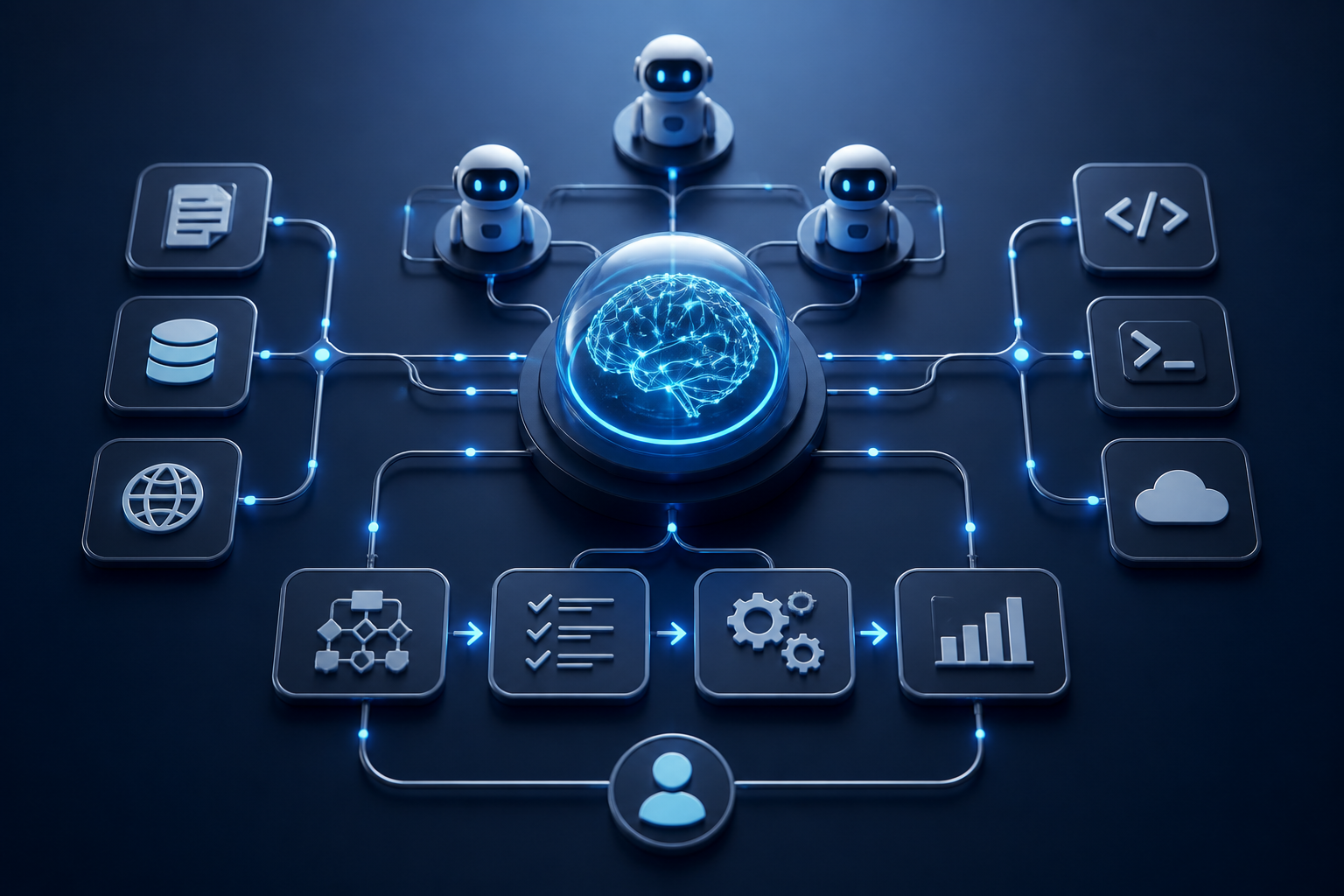
The artificial intelligence ecosystem has undergone a fundamental structural shift. The paradigm of simple prompt-response interactions with Large Language Models (LLMs) has evolved into agentic systems—software architectures where autonomous AI agents perceive context, plan complex multi-step execution paths, invoke external computational tools, retain persistent state, and collaborate to achieve open-ended goals.
As organizations transition from experimental chatbots to production-grade agentic workflows, software architects, engineering leaders, and automation specialists face a critical challenge: selecting the appropriate technology stack. The market for AI agent platforms is split between code-first SDKs, cyclic state machines, visual low-code integration platforms, and fully autonomous enterprise environments.
This technical buyer’s guide provides an exhaustive analysis of the best AI agent tools for 2026. We evaluate each platform across architectural capabilities, execution efficiency, memory handling, security guardrails, and enterprise integration potential to assist you in making an informed infrastructure decision.
1. Executive Summary & Market Landscape
The primary distinction between standard LLM chains and AI agents lies in autonomy, looping, and state evaluation. A linear LLM chain executes a fixed sequence of operations (A → B → C). An AI agent, by contrast, operates inside a dynamic feedback loop: it evaluates its environment, determines whether a goal has been reached, dynamically selects tools, processes outputs, and iteratively adjusts its plan until task completion or failure.
To navigate this landscape, tools can be grouped into four distinct categories:
- Developer-First Frameworks & State Orchestrators: Python/TypeScript libraries (e.g., LangGraph, CrewAI, AutoGen) designed for precise code-level control over state transitions, cyclic execution graphs, and multi-agent routing.
- Low-Code / Visual Workflow Orchestrators: Hybrid platforms (e.g., n8n, Flowise, Langflow) that combine deterministic, event-driven node workflows with non-deterministic LLM reasoning agents, ideal for rapid deployment and cross-system enterprise integration.
- Autonomous Developer & Vertical Platforms: Specialized end-to-end agents (e.g., Devin, Cursor, SuperAGI) engineered to perform domain-specific jobs, such as software development, web research, or vulnerability remediation, with minimal human intervention.
- Managed Enterprise Cloud Platforms: Foundation model providers offering managed agent execution layers (e.g., AWS Bedrock Agents, Azure AI Agent Service) built around cloud IAM, native VPC boundaries, and enterprise governance compliance.
Quick Comparison: Top AI Agent Tools at a Glance
| Tool / Framework | Primary Paradigm | Target Audience | State Management | Self-Hosting | Primary Use Case |
|---|---|---|---|---|---|
| LangGraph | Cyclic Graph / Code-First | Software Engineers, AI Architects | Persistent, explicit state graphs | Yes (Open source / LangGraph Server) | Complex cyclic logic, stateful multi-agent systems |
| CrewAI | Role-Based / Multi-Agent | Python Engineers, Automation Engineers | Task-driven contextual passing | Yes (Open source library) | Collaborative multi-agent teams with discrete roles |
| Microsoft AutoGen | Conversational Orchestration | AI Researchers, Enterprise Developers | Event-driven message streams | Yes (Open source library) | Multi-agent chat, complex automated negotiation/coding |
| n8n (AI Agent Nodes) | Low-Code Workflow Engine | Automation Engineers, DevOps, IT Teams | Workflow execution state & Chat Memory | Yes (Self-hostable, Docker, Cloud) | Hybrid deterministic integrations with AI agent nodes |
| LlamaIndex (Agents) | Data-Augmented RAG Agents | Data Engineers, AI Specialists | Data index context & memory | Yes (Open source library) | Complex document querying, retrieval-heavy agent tasks |
| Flowise / Langflow | Visual Node Graph | Prototypers, Low-code Developers | Node-based visual state | Yes (Open source) | Rapid prototyping of LangChain/LlamaIndex agents |
| AWS Bedrock Agents | Managed Cloud Service | Enterprise Cloud Architects | AWS managed session context | No (Managed Cloud) | Secure enterprise AWS tool execution & knowledge bases |
2. Foundational Concepts: Anatomy of an AI Agent
Before evaluating specific frameworks, we must establish a clear technical taxonomy for what constitutes an AI agent tool. An agent is not simply an API wrapper around an inference call; it is a software system comprising five core functional components:
The Functional Architecture of an Autonomous AI Agent
Perception Input → Reasoning Core (LLM) ↔ Memory Layer (Short/Long-Term) ↔ Tool Calling Engine → Environmental Output → Feedback Loop.
2.1 The Reasoning Core (LLM Engine)
The reasoning core serves as the cognitive controller. It processes incoming task prompts, system constraints, environmental feedback, and context windows to emit structured instructions. Modern agent frameworks rely heavily on Structured Outputs (e.g., Pydantic schema validation or OpenAI JSON mode) to convert unstructured LLM reasoning into machine-executable actions.
2.2 Memory Layer Architecture
Agent memory is bifurcated into two essential storage types:
- Short-Term / Working Memory: Manages current conversation turns, active context variables, tool response logs, and runtime call stack history within the context window.
- Long-Term / Persistent Memory: Utilizes vector stores (e.g., Qdrant, Pinecone, PGvector) for semantic retrieval (Episodic Memory) or relational/key-value databases (e.g., PostgreSQL, Redis) for procedural knowledge and user profile state (Procedural Memory).
2.3 Tool Integration & Function Execution Engine
Agents interact with the world through Tools—typed interfaces exposing external APIs, databases, code execution sandboxes, web scrapers, or local file systems. A robust agent platform provides strict schema parsing, asynchronous execution, retry parameters, and exception handling when an agent supplies malformed function parameters.
2.4 Planning & Reflection Mechanisms
Advanced agentic systems implement explicit planning strategies to break down monolithic objectives into execution graphs:
- ReAct (Reason + Act): Interleaved chain of thought reasoning followed by discrete tool invocation and observation parsing.
- Plan-and-Solve: Upfront generation of sub-task lists with dynamic execution and dynamic plan re-evaluation based on sub-task outcomes.
- Refinement / Reflection Loops: Secondary evaluation nodes where an agent critique node checks generated outputs against constraint policies before declaring task completion.
2.5 Multi-Agent Topologies
When tasks exceed the cognitive boundary or context limits of a single agent, systems deploy multi-agent topologies:
- Sequential Routing: Agent A processes raw data, passes structured output to Agent B, which hands off to Agent C.
- Hierarchical Orchestrator-Worker: A supervisor agent parses high-level requests, delegates sub-tasks to specialized worker agents, aggregate their results, and resolves conflicts.
- Swarm / Peer-to-Peer Consensus: Autonomous agents communicate via a shared event bus, claiming tasks based on specialized roles and negotiating intermediate state transitions.
3. Comprehensive Evaluation Criteria for AI Agent Tools
When selecting an agent platform for technical teams or enterprise infrastructure, generic benchmarks are insufficient. Platforms must be systematically measured across seven critical architectural criteria:
1. State Machine Determinism & Loop Control
Does the platform support explicit cyclic state graphs with checkpointing, or does it rely on unbounded execution loops? Production systems require deterministic limits, execution timeouts, conditional routing branching, and human-in-the-loop (HITL) interrupt points.
2. Tool Schema Robustness & Execution Sandboxing
How does the framework validate function arguments generated by the model? Does it execute code in isolated container sandboxes (e.g., Docker, E2B microVMs) to prevent arbitrary code execution vulnerabilities?
3. Multi-Agent Orchestration Flexibility
Does the tool support dynamic delegation, role abstraction, and inter-agent message passing? Is shared memory handled cleanly without context contamination?
4. Observability, Tracing, and Telemetry
Can developers inspect intermediate agent reasoning steps, view latency breakdowns per tool invocation, track token consumption, and replay failed execution branches? Native compatibility with OpenTelemetry, LangSmith, or Phoenix (Arize) is essential for debugging production state machines.
5. Enterprise Security & Governance
How are API credentials, database connection strings, and sensitive context fields isolated? Are there built-in mechanisms for prompt injection mitigation, role-based access control (RBAC), and compliance auditing (SOC2, HIPAA)?
6. Infrastructure Footprint & Deployment Flexibility
Can the framework run fully air-gapped on-premises or within a private cloud (VPC)? Can it leverage local open-weight models via Ollama or vLLM without vendor lock-in to commercial API providers?
7. Developer Experience (DX) & Ecosystem Maturity
What is the quality of documentation, typing support (Python static typing, TypeScript interfaces), visual debugging utilities, and community support?
4. Developer-First Frameworks & SDKs
For engineering teams building custom, deeply integrated software products, code-first frameworks provide maximum flexibility, fine-grained control, and seamless integration with existing software engineering workflows.
4.1 LangGraph (by LangChain)
Overview: LangGraph represents a major step forward in the LangChain ecosystem. Moving away from traditional linear DAG (Directed Acyclic Graph) chains, LangGraph models agentic applications as stateful, cyclic graphs. This makes it one of the most robust developer frameworks for enterprise agent architectures.
Key Architectural Features
- State Graph Paradigms: Applications are defined as explicit state graphs where nodes represent functions (or LLM calls) and edges represent conditional transitions based on graph state updates.
- Built-In Checkpointing & Persistence: State is saved at every node transition. This enables time-travel debugging, state rollback, and seamless human-in-the-loop (HITL) execution pauses.
- Multi-Agent Team Topologies: Native support for hierarchical, peer-to-peer, and custom multi-agent routing using explicit graph transitions.
- Ecosystem Integration: Direct, native integration with LangChain’s vast library of document loaders, vector store retrievers, and LangSmith tracing.
Technical Considerations
LangGraph introduces a steeper learning curve than standard sequential LLM wrappers. Developers must explicitly define state schemas (e.g., using Python TypedDict or Pydantic) and graph edge conditions. However, this architectural overhead pays off in determinism, fault tolerance, and production reliability.
# Architectural Concept: Basic LangGraph State Node Definition
from typing import TypedDict, Annotated, Sequence
import operator

class AgentState(TypedDict):
    messages: Annotated[Sequence[str], operator.add]
    next_step: str
    is_authorized: bool

def planning_node(state: AgentState):
    # Process active graph state and evaluate next transition
    latest_message = state['messages'][-1]
    if "REQUIRES_APPROVAL" in latest_message:
        return {"next_step": "human_approval_node"}
    return {"next_step": "tool_execution_node"}
4.2 CrewAI
Overview: CrewAI focuses on role-based autonomous multi-agent systems. Built with engineering simplicity in mind, CrewAI allows developers to structure autonomous software teams where individual agents act as specialized persona roles (e.g., “Senior Researcher”, “Backend Engineer”, “Quality Analyst”) collaborating on structured task lists.
Key Architectural Features
- Role-Based Abstraction: Agents are defined by distinct Roles, Goals, Backstories, and assigned Tool sets.
- Flexible Execution Processes: Supports both Sequential (task step-by-step handoff) and Hierarchical task processes where a dedicated Manager Agent dynamically delegates sub-tasks.
- Delegation & Inter-Agent Communication: Agents can autonomously delegate tasks to peers if they lack specific tools or context, receiving back intermediate structured responses.
- Memory Layer Integration: Out-of-the-box integration with short-term, long-term, and entity memory systems powered by vector databases.
Strengths & Limitations
CrewAI excels at rapid deployment of collaborative text-and-reasoning teams. Its Pythonic syntax is highly readable and quick to implement. However, for highly custom cyclic logic, complex low-level graph orchestration, or strict deterministic state machines, CrewAI offers less granular control than LangGraph.
4.3 Microsoft AutoGen
Overview: Developed by Microsoft Research, AutoGen is a powerful framework for building multi-agent conversational topologies. It models agents as entity components that communicate by passing structured event messages within shared or targeted conversations.
Key Architectural Features
- Conversational Multi-Agent Pattern: Complex tasks are solved through multi-agent discussions, debate, and joint execution loops.
- Native Code Execution Environment: AutoGen includes robust built-in support for agents to generate, execute, and debug code locally or within isolated Docker containers.
- Human-in-the-Loop Integration: Seamlessly inject human input into multi-agent conversation threads at configured step intervals or error boundaries.
- Flexible Agent Customization: Easily mix LLM-backed agents, tool-calling agents, human proxy agents, and rule-based deterministic modules within a single discussion framework.
Best Use Cases
AutoGen is exceptionally well-suited for automated software engineering, scientific research simulation, automated code refactoring, and multi-agent negotiation tasks where conversational feedback and code execution loops are primary drivers.
4.4 LlamaIndex (Agentic Framework)
Overview: While initially recognized as a Retrieval-Augmented Generation (RAG) framework, LlamaIndex has evolved robust agentic orchestrators specifically designed for data-augmented tasks, structured enterprise search, and complex document intelligence.
Key Architectural Features
- Data-First Agents: Agents treat vector indexes, knowledge graphs, and relational databases as dynamically querying tools.
- Query Engine Tools: Seamlessly wraps complex sub-question retrieval engines into callable tools that an agent can invoke dynamically.
- Workflows & Event-Driven Architecture: Modern LlamaIndex features a light event-driven execution framework for building complex data handling loops.
Ideal Application Scenarios
LlamaIndex is the premier choice when an agentic system’s primary job is navigating, aggregating, synthesizing, and reasoning across massive, unstructured, multi-source enterprise document repositories.
4.5 Microsoft Semantic Kernel
Overview: Semantic Kernel is an enterprise-focused SDK developed by Microsoft, built primarily for C#, Python, and Java developers. It focuses on enterprise-grade modularity, strongly typed AI plugins, and native integration with modern enterprise corporate stacks.
Key Architectural Features
- Strongly Typed Plugins & Native Memory: Exposes existing legacy REST APIs and enterprise code as typed plugins directly callable by kernel planners.
- Flexible Planners: Includes sequential, Handlebars, and step-wise planners that transform incoming user intent into orchestratable execution graphs.
- Enterprise Governance Native: Designed from the ground up for corporate software developers who require strict telemetry, enterprise authentication (Azure AD), and enterprise SDK paradigms.
5. Visual Low-Code & Workflow Orchestration Agent Tools
While developer frameworks provide deep code customization, visual low-code and hybrid automation platforms bridge the gap between software engineers, automation builders, and IT operations teams. These tools allow for rapid workflow assembly, high-visibility visual debugging, and seamless integration with hundreds of enterprise SaaS platforms.
5.1 n8n (Advanced AI Agent Orchestration)
Overview: n8n has established itself as an enterprise-grade platform for hybrid workflow automation. By seamlessly fusing deterministic workflow nodes with non-deterministic dynamic AI agent nodes, n8n allows organizations to run agentic loops alongside secure, enterprise-wide API integrations.
Hybrid Architecture in n8n: Deterministic Logic + Agentic Reasoning
Trigger (Webhook/Event) → Deterministic Payload Validation → AI Agent Node (LLM + Dynamic Tools + Vector Memory) → Deterministic Database Commit & Notification.
Key Architectural Features
- Native AI Agent Nodes: n8n features dedicated LangChain-powered AI Agent nodes that operate as autonomous execution cores inside broader workflows.
- Modular Tool Binding: Bind any of n8n’s 400+ native SaaS connectors (e.g., Jira, Slack, Salesforce, PostgreSQL, GitHub) directly as executable tools for an AI agent node with zero boilerplate code.
- Granular Memory & Vector Integration: Connect chat memory modules (Window Buffer, Postgres Chat Memory) and vector stores (Qdrant, Pinecone, PGvector) directly via an intuitive visual graph interface.
- Hybrid Deterministic-Agent Workflows: Wrap volatile, non-deterministic agentic reasoning steps inside strict deterministic control structures (e.g., IF/ELSE validation, Schema Enforcers, Rate Limiters, Approval Hooks).
- Complete Self-Hosting & Data Privacy: Easily deployed via Docker/Kubernetes inside private clouds, satisfying stringent HIPAA, GDPR, and enterprise data security parameters without sending data to third-party visual flow hosts.
Production Use Case Profile
n8n is ideal for enterprise automation teams building self-healing IT pipelines, customer support triage agents, complex CRM synchronization loops, and document processing systems where visual observability, data sovereignty, and rich API access are paramount.
5.2 Flowise & Langflow
Overview: Flowise and Langflow are open-source UI visual builders designed to construct LangChain and LlamaIndex pipelines using drag-and-drop node canvases.
Key Architectural Features
- Visual Component Mapping: Drag and drop LLM components, prompt templates, memory modules, vector stores, and custom tools into explicit execution graphs.
- Rapid API Generation: Instantly convert a visual flow into a production-ready REST API endpoint or embeddable widget code wrapper.
- Custom Code Nodes: Inject custom Python or JavaScript functions into the visual graph to execute precise data transformations between nodes.
Best Use Cases
These platforms excel at rapid prototyping, educational modeling, and building straightforward RAG or simple agent applications where building a custom frontend UI would be redundant.
5.3 Business Automation Platforms: Zapier Central & Make AI
Overview: Zapier Central and Make’s AI Assistant tools bring light agentic capabilities to business automation power users. Rather than operating as full-fledged software developer platforms, they provide declarative natural language control over traditional SaaS integrations.
Key Differences Compared to Developer Frameworks
- Abstraction Layer: Complete abstraction over code execution, low-level state machines, and system memory parameters.
- Target Audience: Operations staff, marketing teams, and non-developer business analysts requiring automated task routines without custom software hosting.
- Limitations: Reduced flexibility for complex multi-agent handoffs, custom code sandboxing, low-latency execution, or on-premises deployment constraints.
6. Enterprise-Grade & Autonomous Agent Platforms
Beyond developer frameworks and workflow orchestrators lie dedicated autonomous agent systems engineered for end-to-end task execution and cloud-native managed workloads.
6.1 Autonomous Developer Agents: Devin (Cognition AI), Cursor, and Windsurf
Specialized autonomous agents have transformed software engineering workflows:
- Devin: Acts as an autonomous software engineering teammate capable of planning, reading documentation, executing shell commands within a sandboxed terminal, writing code, running test suites, and opening pull requests independently.
- Cursor & Windsurf: IDE-native agentic environments that leverage contextual codebase indexing, fast terminal tool execution, and local file diff edits to act as real-time pair programmers under direct developer supervision.
6.2 Open Autonomous Execution Frameworks: AgentGPT and SuperAGI
Open-source web-based autonomous agent execution frameworks allow users to deploy task-driven agents that recursively formulate sub-goals, query web APIs, execute browser automation, and append intermediate results to global goal queues until completion.
6.3 Managed Cloud Agent Infrastructure: AWS Bedrock Agents & Azure AI Agent Service
For organizations strictly committed to hyper-scaler cloud footprints, managed cloud agent services provide a reliable choice:
- AWS Bedrock Agents: Fully managed agent orchestrators that connect Amazon Bedrock foundation models to enterprise data stores (Knowledge Bases) and AWS Lambda functions without managing underlying server orchestration. Built-in compliance with AWS IAM access control and CloudTrail logging.
- Azure AI Agent Service: Managed enterprise infrastructure built on top of Azure OpenAI, enabling safe tool invocation (Azure Functions, Code Interpreters), semantic search integration, and enterprise-wide data governance controls.
7. Deep Technical Architecture: Memory, Tools, Guardrails & Telemetry
Building production-ready AI agent tools requires moving beyond basic API calls. Success hinges on mastering four underlying technical pillars: state persistence, function schemas, guardrail execution, and tracing telemetry.
7.1 State Persistence & Memory Taxonomy
An enterprise agent must reliably store and retrieve state across long operational durations without exceeding model context limits or degrading inference accuracy.
| Memory Pattern | Underlying Storage | Retrieval Mechanism | Primary Use Case |
|---|---|---|---|
| Windowed Buffer | In-Memory / Redis Key | FIFO (First-In, First-Out) sliding window | Short-term chat continuity in low-turn tools |
| Summarized History | Relational DB (PostgreSQL) | LLM background consolidation node | Preserving core context across long conversations |
| Vector Episodic | Vector Stores (Qdrant, Pinecone) | HNSW k-NN Cosine Similarity Search | Retrieving historical task results and user preferences |
| Procedural Graph | Graph DB (Neo4j) | Cypher Queries / Entity Traversal | Maintaining structural relationships, organizational rules |
7.2 Tool Schema Definition & Function Calling Protocols
To ensure agents invoke tools accurately without failing parameter validations, function interfaces must be explicitly structured. The JSON schema standard ensures typed argument serialization:
// Example OpenAI/Anthropic Compatible Tool JSON Schema
{
  "name": "execute_database_query",
  "description": "Executes a read-only SQL query against the enterprise customer analytics database.",
  "parameters": {
    "type": "object",
    "properties": {
      "query": {
        "type": "string",
        "description": "Valid, sanitized SELECT SQL query string."
      },
      "timeout_seconds": {
        "type": "integer",
        "default": 30,
        "description": "Maximum execution time before query termination."
      }
    },
    "required": ["query"]
  }
}
7.3 Guardrails, Alignment & Security Isolation
Directing agents to execute actions introduces security vectors, including prompt injection attacks, malicious file generation, and systemic hallucination loops. Production tools must implement strict defensive architectures:
- Deterministic Input/Output Sanitizers: Frameworks like NeMo Guardrails or Guardrails AI validate incoming strings against schema regexes and classification models prior to LLM processing.
- Isolated Code Execution Sandboxes: Never allow an agent to run terminal commands or Python code directly on host server instances. Use isolated microVM containers (e.g., E2B, Docker, Firecracker) with short lifespans, zero network routing options, and strict CPU resource caps.
- Least Privilege API Permissions: API keys provided to agent tools must follow strict scoping principles (e.g., read-only database connections, dedicated staging webhooks).
7.4 Telemetry, Observability & Tracing
Debugging non-deterministic multi-agent graphs requires granular observability tools. Every step, tool call, sub-graph handoff, token cost metric, and latency profile must be structured as OpenTelemetry traces.
Agent Execution Trace Sequence
Span 1: Root Call (Agent Invocation) → Span 2: LLM Reasoning Core (Token Usage: 840) → Span 3: Tool Invocation: WebScraper (Latency: 420ms) → Span 4: Reflection Evaluator → Final Return Payload.
Tools like LangSmith, Arize Phoenix, Helicone, and Log10 allow developers to capture full trace trees, isolate failing nodes, analyze token efficiency, and export problematic runs into evaluation test sets.
8. Real-World Architectural Patterns & Industrial Use Cases
To understand how these tools operate in practice, let us examine three proven implementation patterns designed for technical workloads.
Pattern 1: Automated Customer Operations with Human-In-The-Loop Approval
Goal: Process customer refund requests securely using an agentic flow without giving an unmonitored model direct authorization to execute monetary transactions.
Stack: n8n (Visual Workflow Core) + Postgres Chat Memory + Stripe Tool Binding + Human Approval Hook.
Customer Email Received → n8n AI Agent Node analyzes sentiment and checks policy via Vector DB → Agent formulates refund proposal → Execution flow pauses, triggering an interactive Slack notification to Support Lead → Manager clicks “Approve” → Deterministic n8n node calls Stripe API to execute refund → Email response sent.
Pattern 2: Self-Healing Enterprise ETL Data Pipelines
Goal: Recover automatically from unexpected schema updates or API payload changes in hourly data import jobs.
Stack: LangGraph + Python + Webhook Alerts.
Implementation Logic: When a standard ETL script encounters a schema parsing failure, the system routes the exception payload to a specialized Data Repair Agent Node. The agent inspects the raw payload, dynamically maps fields to the new destination schema, runs a test batch in a sandbox container, and upon validation, commits the clean batch while submitting a patch PR to the main repository.
Pattern 3: Multi-Agent Software Feature Refactoring
Goal: Autonomously refactor legacy codebases from Python 2 to modern typed Python 3.12 with complete test suite enforcement.
Stack: CrewAI or AutoGen + Docker Sandboxed Execution.
- Architect Agent: Reads source files, map dependency tree, generates step-by-step migration plan.
- Coder Agent: Converts legacy syntax, adds Pydantic models and explicit type hints file by file.
- Testing Agent: Executes
pytestinside an isolated Docker sandbox container. Reads error stack traces and loops back code corrections to the Coder Agent until tests pass 100%. - Reviewer Agent: Evaluates clean diffs against PEP 8 style requirements and outputs a pull request summary.
9. Common Pitfalls, Failure Modes & Edge Case Management
Building production-grade agentic architectures requires preparing for systemic edge cases unique to non-deterministic execution loops.
1. Infinite Execution Loops & Runaway API Costs
Symptom: An agent encounters a tool failure, misinterprets the failure response, and repeatedly invokes the same tool in an infinite loop, consuming millions of API tokens in minutes.
Mitigation Strategy: Enforce strict global execution parameters. Implement continuous step counters (e.g., maximum 10 tool iterations per session), strict runtime timeout controls (e.g., 120 seconds absolute limit), and hard financial budget caps at the API gateway layer.
2. Context Window Degradation (“Lost in the Middle”)
Symptom: As an agent’s execution loop progresses and tool response logs expand, performance drops. The agent forgets system rules defined in the initial system prompt or hallucinates prior intermediate tool results.
Mitigation Strategy: Implement active context pruning. Use intermediate summarization nodes to compress historical turns into concise procedural state markers, discarding raw tool execution payloads once processed.
3. Hallucinated Tool Arguments & Schema Violation Cascades
Symptom: The LLM generates invalid JSON or invokes function arguments that do not conform to the defined schema specification.
Mitigation Strategy: Utilize strict structural enforcement models (e.g., Pydantic schema wrappers). When a tool argument parsing error occurs, catch the validation exception deterministically, feed the exact error string back to the model as an observation turn, and request an immediate parameter correction.
4. Non-Deterministic State Drift
Symptom: Identical user input prompts produce radically divergent, unpredictable multi-step agent execution paths across different run instances.
Mitigation Strategy: Decouple deterministic business routing logic from non-deterministic agentic reasoning. Use structured state machines (such as LangGraph or n8n workflows) to lock high-level application routing into explicit node paths, utilizing agent reasoning strictly within restricted individual node evaluations.
10. Implementation Guide: Building a Production-Ready Agentic Workflow
To demonstrate practical implementation, let us walk through configuring a robust, state-managed agent framework capable of autonomous web research, data extraction, and structured JSON output using Python and modern state machine principles.
Step 1: Environment Setup & Dependency Declaration
Set up an isolated virtual environment and install dependencies, ensuring structural typing, LLM SDKs, and state persistence drivers are cleanly defined.
# Create clean environment and install framework SDKs
python3 -m venv agent_env
source agent_env/bin/activate
pip install langgraph langchain-openai pydantic tavily-python
Step 2: Defining the Explicit System State Schema
Establish a typed Pydantic or TypedDict structure to represent the exact context fields maintained across node graph iterations.
from typing import TypedDict, Annotated, List
import operator

class ResearchAgentState(TypedDict):
    task_description: str
    search_queries: List[str]
    retrieved_documents: List[str]
    synthesized_report: str
    iteration_count: int
    is_complete: bool
Step 3: Tool Function Registration with Explicit Schemas
Expose external web search capabilities to the agent using strongly typed function signatures.
from langchain_community.tools.tavily_search import TavilySearchResults
from langchain_core.tools import tool

@tool
def execute_web_search(query: str) -> str:
    """Executes a real-time web search query to retrieve targeted domain documentation."""
    search_engine = TavilySearchResults(max_results=3)
    results = search_engine.invoke({"query": query})
    return str(results)
Step 4: Constructing Graph Nodes & Conditional Routing Edges
Assemble the cognitive graph. Define execution nodes for query generation, tool execution, output evaluation, and explicit conditional exit edges.
from langgraph.graph import StateGraph, END

# Initialize the State Graph
builder = StateGraph(ResearchAgentState)

# Node 1: Planner Node
def planner_node(state: ResearchAgentState):
    # Formulate queries and update state
    count = state.get("iteration_count", 0)
    return {
        "search_queries": [f"{state['task_description']} industry analysis"],
        "iteration_count": count + 1
    }

# Node 2: Execution Node
def search_execution_node(state: ResearchAgentState):
    query = state["search_queries"][-1]
    docs = execute_web_search.invoke(query)
    return {"retrieved_documents": [docs]}

# Node 3: Evaluation & Synthesis Node
def evaluator_node(state: ResearchAgentState):
    if len(state["retrieved_documents"]) > 0 or state["iteration_count"] >= 3:
        return {"synthesized_report": "Valid data retrieved.", "is_complete": True}
    return {"is_complete": False}

# Conditional Routing Logic
def should_continue(state: ResearchAgentState):
    if state.get("is_complete"):
        return END
    return "search_execution_node"

# Attach Nodes and Edges
builder.add_node("planner_node", planner_node)
builder.add_node("search_execution_node", search_execution_node)
builder.add_node("evaluator_node", evaluator_node)

builder.set_entry_point("planner_node")
builder.add_edge("planner_node", "search_execution_node")
builder.add_edge("search_execution_node", "evaluator_node")
builder.add_conditional_edges("evaluator_node", should_continue)

# Compile into production-ready state graph instance
production_agent_app = builder.compile()
11. Frequently Asked Questions
What is the difference between an AI workflow and an AI agent?
An AI workflow follows a fixed, deterministic sequence of steps (e.g., Step A → Step B → Step C) where an LLM may perform simple data transformations at set points. An AI agent operates within a dynamic feedback loop: it evaluates its current context, formulates sub-goals, selects which tools to invoke, processes execution errors, and autonomously loops until it satisfies a global completion condition.
Should my organization choose a code-first framework or a low-code platform like n8n?
Choose a code-first framework (e.g., LangGraph, CrewAI) if you are software engineers embedding agentic core logic directly into custom SaaS products, requiring version-controlled code repos, complex unit tests, and low-level memory graph manipulation. Choose a low-code platform (e.g., n8n) if you need to rapidly integrate AI agents with enterprise SaaS stacks (CRM, ticketing, databases), maintain continuous visual observability for operations teams, or self-host workflows within secure private clouds with minimal code boilerplate.
How can developers prevent AI agents from getting stuck in infinite tool loops?
Infinite execution loops are mitigated by enforcing hard deterministic boundaries at the orchestrator layer. This includes configuring maximum step iteration limits (e.g., halting after 10 loops), configuring overall execution timeouts (e.g., 120 seconds max), tracking tool call repetition vectors, and implementing human-in-the-loop (HITL) interrupt hooks when execution loops hit error limits.
Are self-hosted open-weight LLMs viable for powering complex agentic tools?
Yes. Modern open-weight models (e.g., Llama 3.3 70B, Qwen 2.5 Coding models) served via inference engines like vLLM or Ollama possess excellent native function calling and structured JSON capabilities. While smaller models may require tighter prompt constraint guards than frontier proprietary models (e.g., Claude 3.5 Sonnet, OpenAI o3-mini), they provide absolute data privacy, zero API per-token costs, and fully air-gapped operational viability.
How do enterprise teams secure AI agents against prompt injection attacks?
Securing agentic tools requires defense-in-depth architecture: sanitizing incoming user inputs using dedicated guardrail nodes (e.g., NeMo Guardrails), enforcing strict structural output parsing (Pydantic schema validation), isolating terminal and code execution routines within single-use container sandboxes (e.g., E2B, Docker), and applying least-privilege scoping to all external API integrations.
Why is state management so crucial for production-grade multi-agent platforms?
State management keeps track of context, task completions, tool responses, and variable updates as an agent moves through execution loops. Without explicit state checkpointing, agentic systems suffer from context window degradation, lose track of multi-step task goals, cannot recover gracefully from transient network failures, and offer no mechanism for time-travel debugging or human intervention.
12. Strategic Conclusion & Buyer Decision Framework
The selection of the ideal AI agent tool is ultimately governed by your team’s technical capabilities, system complexity, security posture, and deployment constraints. There is no single “best” tool for every architectural pattern; rather, the optimal technical choice depends on matching platform mechanics to your core operational goals.
Final Recommendation Decision Matrix
- Select LangGraph if you are building complex, highly custom, stateful software applications where explicit graph structures, time-travel state rollbacks, and code-level deterministic control are required.
- Select n8n if your priority is rapidly building enterprise-grade agentic workflow automations, integrating agents across hundreds of enterprise SaaS APIs, maintaining visual operational observability, and deploying inside self-hosted private clouds.
- Select CrewAI if you need to quickly deploy collaborative, role-based multi-agent teams focused on unstructured reasoning, content generation, or analytical research workflows.
- Select AutoGen if your target application revolves around advanced multi-agent conversational debate, software code generation loops, and interactive terminal debugging environments.
- Select LlamaIndex if your system’s core function is navigating, synthesizing, and reasoning across vast, heterogeneous enterprise knowledge bases and complex RAG document pipelines.
- Select AWS Bedrock Agents / Azure AI Agent Service if your organization requires managed cloud infrastructure operating strictly within existing corporate IAM cloud boundaries and regulatory frameworks.
By establishing rigorous evaluation criteria, prioritizing state determinism, enforcing sandboxed tool execution environments, and selecting the framework aligned with your infrastructure paradigm, engineering teams can build resilient, production-ready AI agent systems that deliver long-term business value.
