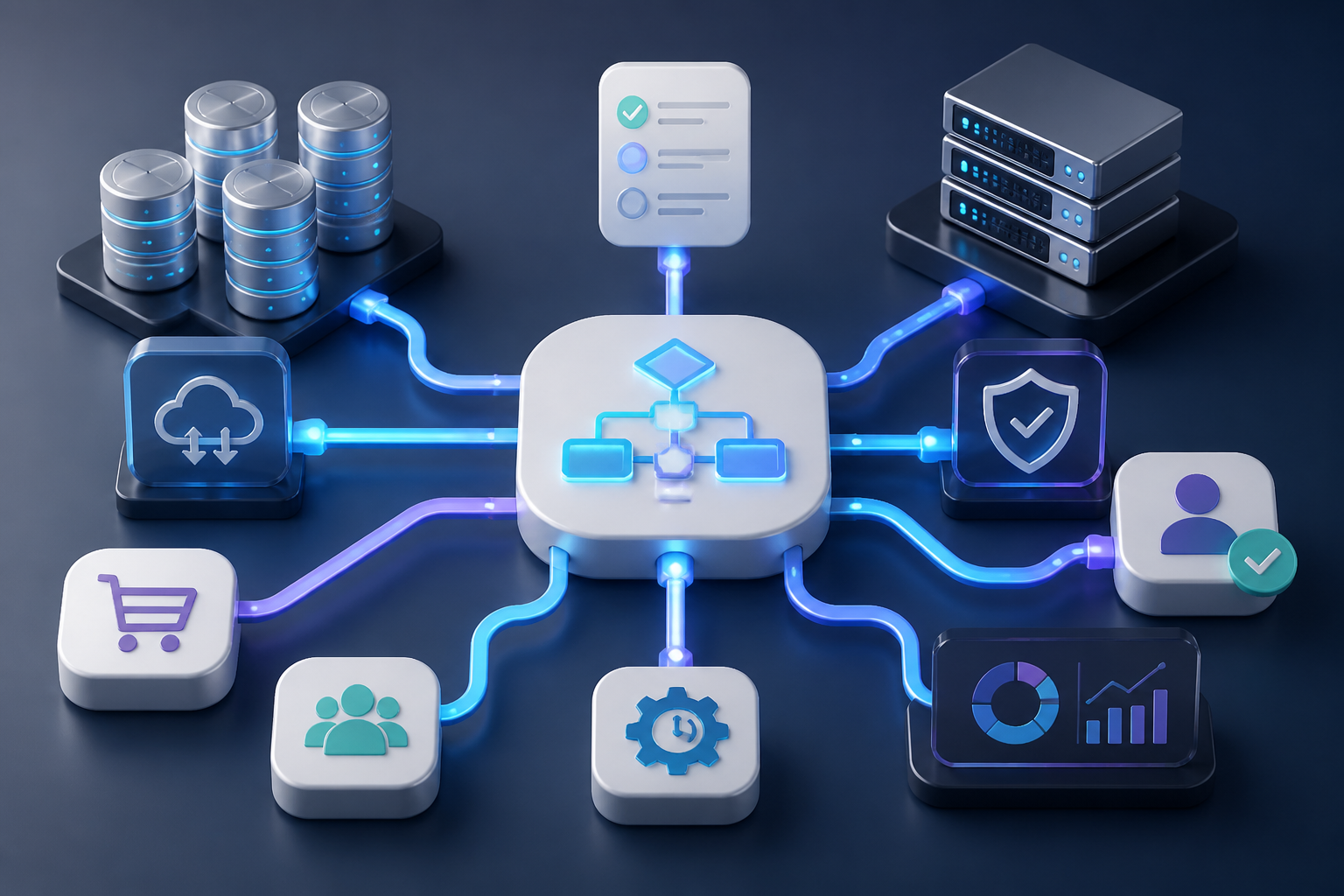
Modern organizations frequently operate under the weight of operational complexity, fragmented cloud services, legacy databases, and manual data-entry bottlenecks. As enterprises scale, relying on manual human intervention to bridge disparate operational software leads to high error rates, delayed cycle times, and soaring operational expenditures. Business process automation (bpa) solves these systematic failures by applying software-driven orchestration, system integration, and rule-based workflow logic across entire operational pathways.
Unlike rudimentary single-task macros or isolated task automations, business process automation (bpa) reorganizes complete multi-step, multi-system operational flows. It establishes seamless data synchronization, structural rule enforcement, real-time event triggers, state persistence, and human-in-the-loop decision checkpoints across modern IT infrastructure. This definitive guide provides technical leaders, workflow architects, and engineering teams with an architectural blueprint for understanding, engineering, and scaling enterprise-grade BPA systems.
1. Executive Summary & Foundational Concepts
Business Process Automation (BPA) is the technology-enabled execution of recurring, multi-step business transactions or operational procedures to minimize manual overhead, ensure compliance, and maximize execution speed. Rather than optimizing isolated actions, BPA targets entire enterprise value chains—such as end-to-end order-to-cash processing, employee onboarding, regulatory compliance auditing, and multi-channel customer lifecycle management.
To successfully architect modern automation solutions, technical decision-makers must distinguish between related but distinct disciplines in the automation ecosystem: Business Process Automation (BPA), Robotic Process Automation (RPA), Business Process Management (BPM), and emerging Autonomous Agentic Automation.
| Dimension | Business Process Automation (BPA) | Robotic Process Automation (RPA) | Business Process Management (BPM) | Agentic AI Automation |
|---|---|---|---|---|
| Primary Focus | End-to-end API & data integration across enterprise software systems. | Emulating human UI actions (clicks, screen scraping) on legacy systems. | Process optimization, modeling, governance, and organizational re-engineering. | Dynamic decision-making, adaptive routing, and autonomous task execution. |
| Integration Level | Deep system level (APIs, Webhooks, Database CDC, Event Buses). | Surface application level (User Interface, OS macros, Virtual Desktops). | Methodological & Orchestration level (BPMN 2.0 notation, policy layers). | Cognitive level (LLMs, neural reasoning, unstructured data evaluation). |
| Flexibility | High structural flexibility through structured API schemas (JSON/XML). | Low structural flexibility; breaks when software UI layouts change. | High governance focus; rigid business process modeling standards. | Extremely high adaptive flexibility; handles ambiguity and unstructured inputs. |
| State Management | Stateful workflow engines with database-backed state persistence. | Stateless or session-bound execution environments. | Long-running process engines with full lifecycle audit persistence. | Dynamic state graphs with memory buffers and vector store retrieval. |
| Ideal Use Case | Modern cloud integration, e-commerce backend processing, ERP synchronization. | Legacy software lacking public APIs, legacy desktop enterprise applications. | Large-scale enterprise process re-engineering and compliance frameworks. | Complex document extraction, customer sentiment routing, unstructured processing. |
Defining the Scope of Modern BPA
At its technical core, business process automation (bpa) sits at the intersection of application integration, event-driven processing, and rule-based decision engine execution. Modern BPA does not eliminate human governance; rather, it elevates human roles by automating standardized data movement while surfacing edge cases through designed Human-in-the-Loop (HITL) interfaces.
2. The Architectural Spectrum of Automation
Understanding where BPA sits within the broader software engineering ecosystem requires analyzing the architectural spectrum of digital task execution. Systems range from basic programmatic scripting to complex, long-running distributed state machines.
Level 1: Simple Task Automation
Task-level automation focuses on singular, isolated operations. Examples include a shell script running via a local cron job to backup a directory, or an isolated webhook sending an email notification upon a form submission. While effective for localized productivity, simple task automation lacks centralized logging, state persistence, failure handling, or cross-system operational context.
Level 2: Robotic Process Automation (RPA)
RPA operates at the presentation layer (UI). RPA bots simulate human interactions—clicking buttons, navigating browser frames, copying text from desktop interfaces, and executing keystrokes. While RPA bridges gaps in legacy enterprise systems that lack native REST or SOAP APIs, it introduces significant technical debt. UI updates, screen resolution changes, or minor DOM modifications frequently break RPA scripts, requiring heavy ongoing maintenance. Reviewing structured workflow automation platform analysis provides valuable insight into choosing API-first architectures over fragile UI bots.
Level 3: Business Process Automation (BPA) & Workflow Orchestration
BPA bypasses the presentation layer entirely, operating directly at the data and integration layers using RESTful endpoints, GraphQL, gRPC, direct database connection pools, and real-time message buses. A robust BPA solution maintains workflow state, manages authentication securely, guarantees atomic transactional execution, and provides centralized observability across multiple operational touchpoints.
Level 4: Business Process Management (BPM)
BPM is a holistic managerial and architectural discipline aimed at analyzing, modeling, executing, monitoring, and optimizing business processes continuously. BPM provides the overarching methodology and governance framework (often utilizing standard BPMN 2.0 modeling notation), while BPA provides the practical operational engineering stack that implements those models programmatically.
Level 5: Agentic AI Orchestration
The newest evolution in enterprise automation incorporates large language models (LLMs) and cognitive agent loops into BPA architectures. Rather than strictly following deterministic branching logic (e.g., IF x THEN y), agentic automation permits probabilistic decision-making. AI agents evaluate unstructured text, interpret intent, synthesize inputs from multiple APIs, and dynamically decide which downstream action to trigger. Integrating business operations AI agents into standard BPA frameworks allows organizations to automate previously manual tasks such as complex claims handling, email intent triage, and contract analysis.
3. Anatomy of an Enterprise BPA Architectural Stack
Building a resilient, enterprise-ready business process automation architecture requires a modular, layered stack. Each layer handles a specific operational concern, separating triggers from workflow logic, execution states, and audit trails.
1. Trigger & Ingestion Layer
The trigger layer acts as the entry point for process execution. Common architectural patterns include:
- Real-Time Inbound Webhooks: HTTP POST callbacks triggered immediately upon source system events (e.g., new order created in WooCommerce).
- Database Change Data Capture (CDC): Event streaming systems (such as Debezium or Kafka) listening to transaction logs (PostgreSQL WAL or MySQL Binlog) to trigger workflows immediately upon database record changes.
- Message Queues & Event Buses: AMQP or MQTT queues (RabbitMQ, Apache Kafka, AWS SQS) that buffer operational events for asynchronous consumption.
- Scheduled Polling (Cron): Deterministic polling intervals querying REST endpoints for updated records containing modified timestamps.
2. Orchestration & Execution Layer
The core engine responsible for parsing workflow schemas, controlling conditional execution pathways, managing asynchronous waiting states, and handling system payloads. Enterprise platforms like n8n official documentation provide open-architected, node-based visual and programmatic execution environments capable of scaling horizontally across distributed container clusters.
3. Integration & Abstraction Layer
This layer standardizes data schemas across diverse applications. Incoming data from varying vendor payload formats is normalized into standard internal JSON objects. API abstraction layers handle connection pooling, OAuth2 refresh token rotation, header generation, and rate limiting natively.
4. Logic & Decisioning Layer
The business logic subsystem executes rule frameworks using deterministic rule engines (e.g., JSON Schema evaluation, decision tables) or cognitive inference layers (LLMs and vector databases). It evaluates conditions such as customer risk tiering, discount thresholds, or inventory allocation rules.
5. Persistence & State Management Layer
Long-running business processes often require delays, multi-step human approvals, or external system webhooks before reaching completion. The state management engine persists workflow context inside high-reliability databases (PostgreSQL, Redis) to allow seamless re-hydration of execution states after system pauses, reboots, or network retries.
6. Observability, Logging, & Governance Layer
Enterprise BPA requires absolute auditability. Every execution trace must log the exact input parameters, node outputs, execution duration, system credentials utilized, and error traces. Telemetry metrics are exported to monitoring dashboards (Grafana, Datadog, Prometheus) to monitor latency, error rates, and API quota usage.
4. Core Methodologies for Engineering Business Process Automation
Automating a broken or non-standardized process simply accelerates inefficiency. Enterprise software architects follow structured methodologies to analyze, transform, and code business workflows systematically.
Phase 1: Process Discovery & Value-Stream Mapping
Before writing automation code or designing node workflows, architects must map the end-to-end value stream using frameworks like SIPOC (Suppliers, Inputs, Process, Outputs, Customers) or Event-Driven Process Chains (EPC).
- Identify Inputs & Outputs: Detail every payload schema, document type, and data point moving across process boundaries.
- Map Hand-off Bottlenecks: Highlight points where data is manually copied between applications, requiring human translation.
- Quantify Execution Metrics: Establish baseline cycle times, error rates, and operational costs of the manual process.
Phase 2: Process Standardization & Simplification
Eliminate unnecessary approval gates, redundant logging steps, and edge-case exceptions that complicate automated workflow design. Standardize all data models across interacting applications (e.g., ensuring order status field strings match uniform conventions across systems).
Phase 3: Decoupled Event-Driven Architectural Design
Design workflows using event-driven architecture (EDA). Rather than creating tightly coupled monoliths where System A directly calls System B, System C, and System D sequentially, configure systems to emit domain events (e.g., Order.Placed, Customer.Created). The BPA engine subscribes to these events and manages downstream distribution asynchronously.
Phase 4: Human-in-the-Loop (HITL) Pattern Implementation
Not every enterprise task should be fully automated. High-value transactions, risk-sensitive decisions, or low-confidence AI predictions demand human verification. HITL design patterns halt the execution pipeline, generate a state snapshot, notify a user via Slack, Email, or a custom Web Portal, and resume execution only after a validated manual cryptographic approval token is returned.
5. Step-by-Step Implementation Framework
To demonstrate practical execution, let us examine the step-by-step technical implementation of a modern enterprise business process automation project.
Step 1: Define API Schemas and Auth Protocols
Document every API endpoint, authentication mechanism (OAuth2, API Keys, mTLS), rate limit policy, and error format across all target applications. Ensure secrets are stored securely in enterprise key vaults (HashiCorp Vault, AWS Secrets Manager) rather than hardcoded in workflow scripts.
Step 2: Engineer the Workflow Orchestration Pipeline
Construct the workflow using modular software architecture. Below is an example of an event-handling script running within an n8n workflow or Node.js enterprise microservice that receives an incoming webhook, normalizes the schema, validates data structural integrity, and routes processing conditionally:
/**
 * Enterprise BPA Event Normalization & Routing Middleware
 * Validates incoming order payloads and applies automated business logic.
 */

async function processIncomingOrderPayload(rawPayload) {
  // 1. Sanitize & Standardize Input Schema
  const normalizedData = {
    transactionId: rawPayload.id || rawPayload.order_id,
    customerEmail: rawPayload.billing?.email || rawPayload.customer_email,
    orderTotal: parseFloat(rawPayload.total || rawPayload.amount),
    currency: (rawPayload.currency || 'USD').toUpperCase(),
    items: rawPayload.line_items ? rawPayload.line_items.map(item => ({
      sku: item.sku,
      quantity: item.quantity,
      unitPrice: parseFloat(item.price)
    })) : [],
    receivedAt: new Date().toISOString()
  };

  // 2. Structural Schema Validation
  if (!normalizedData.transactionId || !normalizedData.customerEmail) {
    throw new Error('INVALID_PAYLOAD_SCHEMA: Missing critical identification parameters.');
  }

  // 3. Apply Automated Enterprise Decision Logic
  let processTier = 'STANDARD_PROCESSING';

  if (normalizedData.orderTotal >= 10000.00) {
    processTier = 'HIGH_VALUE_HIGH_TOUCH';
  } else if (normalizedData.orderTotal <= 0) {
    processTier = 'FLAG_POTENTIAL_FRAUD';
  }

  // 4. Return Enriched Context Object for Downstream Node Execution
  return {
    status: 'SUCCESS',
    routingKey: processTier,
    payload: normalizedData,
    meta: {
      engineVersion: '2.4.0-bpa',
      environment: process.env.NODE_ENV || 'production'
    }
  };
}

module.exports = { processIncomingOrderPayload };
Step 3: Implement Robust Error Handling & Idempotency
Network timeouts, API outages, and database lock failures inevitably occur. The BPA engine must handle failures gracefully without duplicating actions or dropping events.
- Idempotency Keys: Pass unique transactional headers (e.g.,
Idempotency-Key: order_98234_fulfillment) to ensure downstream APIs do not execute duplicate credit card charges or double-book inventory during retries. - Exponential Backoff Retries: Configure workflow steps to retry failed HTTP calls automatically (e.g., attempt 1: immediately, attempt 2: +5s, attempt 3: +25s, attempt 4: +125s).
- Dead-Letter Queues (DLQ): If all retries fail, isolate the execution context in a persistent DLQ database table, triggering automated administrative alerts for manual investigation.
6. Enterprise BPA Blueprints & Real-World Use Cases
To fully grasp the transformational impact of business process automation (bpa), we must analyze full architectural blueprints across common enterprise operations.
Use Case 1: E-Commerce Order Fulfillment, ERP Sync, & Inventory Reconciliation
Modern online retail requires synchronous integration across storefronts, payment gateways, enterprise resource planning (ERP) systems, third-party logistics (3PL) providers, and customer notifications. Utilizing robust solutions detailed in our e-commerce workflow automation guide demonstrates how technical teams streamline complex digital store operations.
System Workflow Blueprint:
- Trigger: An order status transitions to
Processinginside WooCommerce via a real-time webhooks endpoint. - Validation Node: The BPA orchestrator validates order data, checks inventory availability across regional warehouses via REST APIs, and checks risk scores against fraud databases.
- ERP Ingestion: The workflow transforms the order schema and calls the ERP API (e.g., SAP, NetSuite) to generate an official Sales Order and allocate physical inventory.
- 3PL Dispatch: An API payload is transmitted to the warehouse logistics provider, generating shipping labels and tracking identifiers.
- Customer Communications: The orchestrator updates the WooCommerce order metadata with tracking details, sends a transactional SMS update, and logs the activity in the enterprise CRM.
Use Case 2: Multi-Department Lead Enrichment & Account-Based Sales Routing
In B2B sales operations, manual processing of incoming marketing leads causes response delays, resulting in lost deals. An automated BPA pipeline processes incoming requests rapidly.
System Workflow Blueprint:
- Trigger: A visitor submits an enterprise demo form on WordPress.
- Data Enrichment: The workflow receives the payload and queries enrichment APIs (Clearbit, Apollo, LinkedIn Graph) using the lead’s email domain to append company size, revenue, and tech stack details.
- Cognitive AI Scoring: An integrated LLM node evaluates the enriched profile against historical closed-won profiles to generate an account priority score.
- Dynamic CRM Routing: High-priority leads are assigned to senior enterprise sales reps in Salesforce/HubSpot, generating custom calendar booking links. Low-priority leads are placed into automated nurture email tracks.
- Notification Dispatch: The assigned rep receives a Slack notification detailing lead history, enriched metrics, and suggested meeting agendas.
Use Case 3: Automated Financial Reconciliation & Invoicing
Finance departments spend hundreds of hours manually matching bank statement deposits against issued invoices and accounting ledgers.
System Workflow Blueprint:
- Trigger: Nightly cron job executes bank statement feed extraction via Open Banking APIs or Plaid integration.
- Matching Engine: The BPA engine iterates through incoming transaction records, executing fuzzy matching logic against unpaid invoices stored in Xero/QuickBooks based on payment reference, exact string matches, and monetary thresholds.
- Reconciliation Action: Matched invoices are marked as
Paidautomatically, closing out ledger items. - Exception Handling (HITL): Unmatched transactions exceeding $500 are routed to an administrative dashboard, allowing accountants to match records with a single click.
7. Technical Deep Dive: State Management, Idempotency, and Failure Recovery
Designing enterprise BPA architectures requires deep consideration of distributed system failure modes. When building long-running workflows, architects must account for network splits, node crashes, and vendor downtime.
State Machines in Long-Running Workflows
Processes that span days or weeks—such as employee onboarding, contract sign-offs, or complex physical product manufacturing—cannot reside purely in volatile application memory. BPA engines implement persistent state machine patterns.
When a workflow hits an asynchronous delay (e.g., waiting for a customer signature on a DocuSign webhooks callback), the orchestrator serializes the current JSON execution graph, saves its exact pointer location in a persistent data store, and frees system RAM. Upon receipt of the authenticated external callback event, the state is re-hydrated, and execution resumes from the exact state snapshot.
Ensuring Idempotency Across Non-Idempotent APIs
A core architectural challenge in business process automation (bpa) is handling non-idempotent destination APIs (e.g., endpoints that create a duplicate invoice every time an HTTP POST request is received, even during a network timeout retry). To enforce strict idempotency across non-idempotent endpoints:
- Generate Deterministic Hashes: Combine primary payload fields (e.g.,
MD5(customer_id + order_date + total_amount)) to create a unique fingerprint for the operation. - Check Execution Vault: Query a centralized Redis or PostgreSQL lock registry to see if the hash has already been processed successfully within a defined time window.
- Acquire Distributed Lock: If unprocessed, write a temporary lock record to prevent concurrent duplicate executions, clearing the lock upon successful HTTP response confirmation.
// Example Idempotency Guard Implementation in Node.js
const crypto = require('crypto');
const redis = require('./redisClient');

async function executeIdempotentTransaction(payload, apiCallFunction) {
  // 1. Generate unique deterministic transaction key
  const rawKey = `${payload.customerId}_${payload.timestamp}_${payload.amount}`;
  const transactionHash = crypto.createHash('sha256').update(rawKey).digest('hex');
  const lockKey = `lock:transaction:${transactionHash}`;

  // 2. Attempt atomic distributed lock acquisition in Redis
  const isLocked = await redis.set(lockKey, 'PROCESSING', 'NX', 'EX', 300); // 5 minute TTL

  if (!isLocked) {
    console.warn(`DUPLICATE_EXECUTION_PREVENTED: Hash ${transactionHash} is already executing or completed.`);
    return { status: 'SKIPPED_DUPLICATE', hash: transactionHash };
  }

  try {
    // 3. Execute the target business operation
    const result = await apiCallFunction(payload);

    // Mark lock as PERMANENTLY_COMPLETED
    await redis.set(lockKey, 'COMPLETED', 'EX', 86400 * 30); // Store history for 30 days
    return { status: 'SUCCESS', data: result };
  } catch (error) {
    // Release temporary lock on failure to allow legitimate retry attempts
    await redis.del(lockKey);
    throw error;
  }
}
Security, Governance, and Access Control (RBAC)
Enterprise BPA platform architectures process highly sensitive corporate data, customer personally identifiable information (PII), financial metrics, and access credentials. Robust governance frameworks demand:
- Role-Based Access Control (RBAC): Granular operational permissions ensuring only authorized system admins can view execution logs, alter workflow node logic, or retry failed executions containing PII data.
- Zero-Trust Secret Injection: Credentials, SSH keys, and API tokens must never be written in plain text inside workflow JSON schemas. Instead, inject secrets dynamically at runtime using secure environment variables or vault services.
- Data Masking & Sanitization: Implement automatic log scrubbers that scrub credit card numbers, social security fields, and authorization headers before saving execution outputs to centralized logging databases.
- Compliance & Audit Logs: Immutable append-only audit tracking documenting who deployed workflow modifications, when executions occurred, and what data mutations resulted.
8. Evaluating BPA Platforms & Software Tooling
Selecting the optimal business process automation (bpa) tool stack depends on team technical capability, existing infrastructure, security compliance mandates, and budgetary constraints. When evaluating modern infrastructure, engineering teams navigating complex system migrations look for robust platforms that balance visual workflow orchestration with native state persistence and reliable automatic retries for distributed services.
Enterprise Workflow Orchestration Engines
Platforms like n8n, Camunda, and Temporal provide developer-first, highly extensible environments. n8n offers an open-source, self-hostable node-based execution engine that bridges visual workflow design with custom JavaScript/Python execution. Teams looking to expand their technical stack can explore our in-depth comparison of agentic workflow architecture tools to guide platform selection.
Top RPA Platforms (Legacy Integration Tools)
When enterprise workflows rely heavily on legacy software interfaces lacking public APIs or database connections, organizations turn to dedicated RPA tools. Key enterprise platforms include:
- UiPath: The industry leader in desktop and enterprise UI screen-scraping automation, featuring robust computer vision AI for identifying screen elements.
- Automation Anywhere: Cloud-native RPA platform combining task bots with intelligent document processing capabilities.
- Microsoft Power Automate: Deeply integrated into the Microsoft 365 and Azure ecosystem, supporting both desktop UI flows and cloud API connectors.
- SS&C Blue Prism: Enterprise-grade RPA engineered for high security, strict audit logging, and enterprise governance compliance.
- Kofax RPA: Specializes in automated data extraction, document processing, and web scraping across legacy corporate portals.
Build vs. Buy Evaluation Matrix
| Evaluation Metric | Custom Code / In-House Microservices | Commercial No-Code / Low-Code BPA | Open-Source / Self-Hosted Orchestrators (e.g., n8n) |
|---|---|---|---|
| Initial Setup Speed | Slow (Requires dedicated developer framework setup). | Extremely Fast (Pre-built vendor connectors). | Fast (Visual workflow builder + rapid custom code nodes). |
| Long-Term Maintenance Overhead | High (In-house maintenance of custom API wrappers). | Low (Vendor manages infrastructure & API updates). | Moderate (In-house server management, open platform code). |
| Vendor Lock-In Risk | Zero (Complete ownership of proprietary code base). | High (Proprietary execution formats & cloud lock-in). | Low (Self-hosted docker instances, exported JSON workflows). |
| Total Cost of Ownership (TCO) | High engineering labor cost; low software licensing cost. | High recurring SaaS costs scaling by execution volume. | Optimal cost balance; predictable server infrastructure footprint. |
| Custom Extensibility | Unlimited (Direct code control). | Restricted to vendor extension ecosystems. | Extremely High (Custom custom nodes, embedded code snippets). |
9. Frequently Asked Questions
Can you give me an example of business process automation?
A classic enterprise example of business process automation (bpa) is an end-to-end employee onboarding workflow. When a new hire signs an offer letter, the automated process triggers simultaneously across multiple enterprise applications: creating a user account in Google Workspace / Active Directory, assigning software licenses in Slack and Jira, generating an employee record in HR software (BambooHR or Workday), issuing a hardware procurement ticket to IT support, and scheduling welcome orientation meetings on team calendars—all without requiring manual data entry from HR personnel.
What are the top 5 RPA tools available today?
The top 5 enterprise Robotic Process Automation (RPA) tools widely utilized across enterprise IT ecosystems are:
- UiPath: Renowned for advanced computer-vision interface recognition and enterprise orchestration.
- Automation Anywhere: Offers cloud-native bot execution combined with AI-driven document intelligence.
- Microsoft Power Automate: Ideal for organizations seeking native Windows desktop automation and seamless Microsoft enterprise integration.
- SS&C Blue Prism: Designed for regulated financial and healthcare industries requiring enterprise audit compliance and security controls.
- Kofax RPA: Focused on automated data extraction, browser interaction, and document intelligence.
What is an example of BPM and how does it differ from BPA?
Business Process Management (BPM) is the strategic methodology of mapping, analyzing, and optimizing business operations across an organization. For example, a global hospital network applying BPM would map the complete patient intake value stream, identify regulatory compliance bottlenecks, redesign procedural hand-offs between departments, and establish formal performance SLAs. Business Process Automation (BPA) is the technical software execution layer that automates the specific digital steps within that optimized BPM model—such as automatically validating patient insurance details via direct API calls during digital intake.
How do I automate my business processes systematically?
To systematically automate business processes, follow this five-step engineering roadmap:
- Audit & Map: Document your existing business process end-to-end, defining every input schema, output expectation, software endpoint, and manual bottleneck.
- Simplify Logic: Standardize rules, eliminate unnecessary human approval steps, and clean source data before writing code.
- Select the Orchestration Layer: Choose an API-first automation orchestrator (such as n8n) rather than fragile surface UI macros.
- Build & Test Retries: Construct modular workflows incorporating schema validation, structural error handling, idempotency checks, and dead-letter queue recovery.
- Monitor & Iterate: Deploy centralized logging dashboards to monitor workflow execution latency, error rates, and operational cost savings over time.
What are the primary risks associated with Business Process Automation?
The primary technical risks in BPA include cascading failures caused by unhandled target API changes, data corruption stemming from missing schema validation, security risks from insecurely handled API keys, and operational lockouts when automated processes lack proper Human-in-the-Loop exception handling. Architecting robust fallback routines, automated error alerting, and maintaining developer oversight effectively mitigates these operational risks.
10. Enterprise Implementation Roadmap & Strategic Next Steps
Engineering a scalable business process automation architecture requires balancing immediate quick wins with long-term technical architecture planning. Organizations embarking on enterprise automation should execute against the following strategic phases:
Phase 1: Establish Governance & COE (Center of Excellence)
Form a cross-functional Automation Center of Excellence comprising enterprise architects, security officers, and business process analysts. Define enterprise security guidelines, credential handling protocols, platform deployment standards, and API management policies.
Phase 2: Target High-Impact, Low-Complexity Pilot Projects
Begin by automating structured, high-volume processes that suffer from manual data entry backlogs but possess reliable modern REST APIs (such as e-commerce order routing, automated CRM lead enrichment, or transactional notification workflows). Document ROI metrics, error reductions, and cycle-time optimizations to prove financial impact.
Phase 3: Standardize on an Open, Extensible Orchestration Engine
Avoid vendor lock-in by implementing scalable, API-first orchestration tools. Ensure your chosen platform—whether deployed as self-hosted container clusters using n8n or hybrid enterprise middleware—supports custom code execution, secret store integration, native state management, and real-time event ingestion.
Phase 4: Integrate Advanced Intelligence & Autonomous Agents
Once foundational event-driven BPA workflows run reliably, layer cognitive capability into execution nodes. Deploy LLM nodes to summarize complex unstructured emails, evaluate ambiguous customer support tickets, and extract context from incoming PDF documentation seamlessly.
By transforming fragmented, manual software hand-offs into resilient, stateful, and event-driven automated infrastructure, modern enterprises achieve unprecedented execution speed, eliminate operational error rates, and establish a modern foundation for continuous growth.
