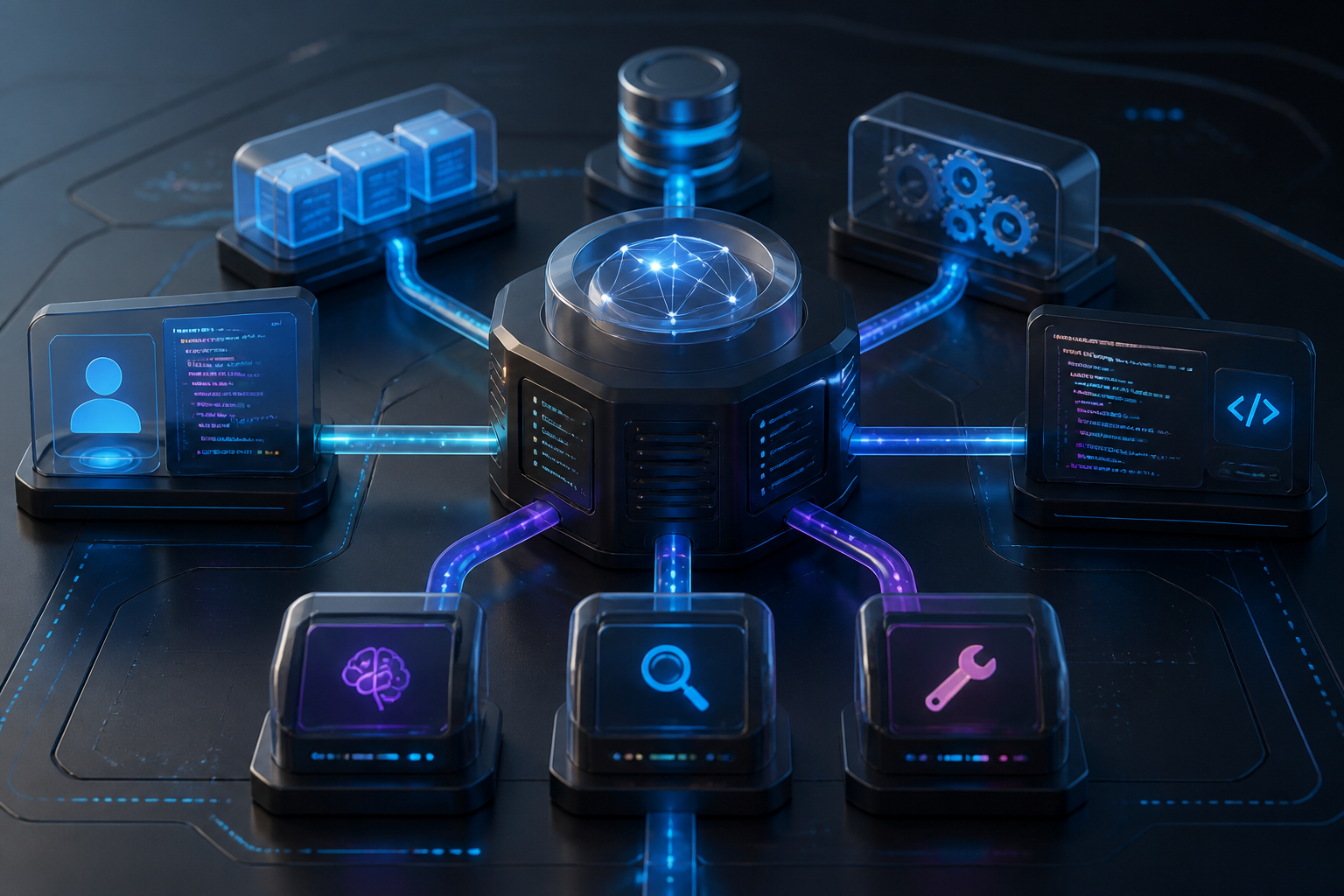
Autonomous AI agents are transitioning from single-prompt terminal interfaces to complex multi-agent systems capable of executing multi-step engineering tasks, managing local system dependencies, and interacting with remote APIs. Central to this paradigm shift in the Google ecosystem is the google antigravity agent manager—the operational orchestration engine designed to manage process lifetimes, local sandboxes, task delegation topologies, and tool execution environments for autonomous Gemini-powered workers.
While developers often begin by evaluating single-agent command-line interfaces (CLIs), enterprise production environments require reliable supervision. The Google Antigravity Agent Manager serves as this supervisory layer, turning disparate prompt configurations into deterministic, resilient, and state-aware agent networks. Before deploying multi-agent topologies, reviewing the underlying Google Antigravity platform fundamentals provides helpful context for how the core CLI interacts with system-level process controls.
This technical guide provides an exhaustive engineering manual for configuring, deploying, extending, and troubleshooting the Google Antigravity Agent Manager. It covers structural mechanics, state preservation, the complete agents.md specification schema, custom skill development, inter-agent IPC routing, and concrete troubleshooting steps for severe execution failures such as the agent terminated due to error runtime crash.
1. Architecture of the Google Antigravity Agent Manager
The Google Antigravity Agent Manager is not merely an API wrapper; it is an out-of-process process supervisor and local IPC (Inter-Process Communication) host designed to run multi-agent routines inside isolated runtime sandboxes. To understand how it orchestrates workloads, developers must first understand its core architectural components.
+-------------------------------------------------------------------------------+| Google Antigravity Agent Manager Daemon || (Process Supervisor & State Router) |+-------------------------------------------------------------------------------+| | |+---------------------------------------+---------------------------------------+| | v v+-------------------------------+ +-------------------------------+| Supervisor Runtime | | Shared Memory & IPC || (Task Scheduler & Event Loop) | | (Context State / Queue) |+-------------------------------+ +-------------------------------+| |-----------------+---------------------------------------+ || v v+-------------------------------+ +------------------+ +------------------+| Primary Router Agent (Gemini) | | Sub-Agent A | | Sub-Agent B || Context Scope: System/Global | | (Code Review) | | (Refactoring) |+-------------------------------+ +------------------+ +------------------+| | || v v+-------------------------------+ +------------------+ +------------------+| Local Tool Sandbox / Skills | | Local OS Hooks | | Remote Webhooks |+-------------------------------+ +------------------+ +------------------+1.1 Process Supervision and Runtime Daemon
When you start the agent manager, it initializes a local control daemon (antigravityd). This daemon acts as a parent process manager for all spawned agent instances. Rather than executing all AI interactions inside a single monolithic thread, the manager maintains separate execution threads—or sub-containers—for each active worker defined in your project.
The daemon is responsible for:
- Process Lifecycle Lifecycle Management: Spawning, monitoring, suspending, and killing sub-agent worker threads based on task completion or resource exhaustion.
- State Synchronization: Maintaining thread safety across file-system reads, writes, and memory mutations shared between agents.
- Resource Governance: Enforcing strict memory, CPU, and token-consumption limits per agent thread to prevent process cascading failure.
- Signal Handling: Intercepting
SIGINT,SIGTERM, andSIGKILLevents to gracefully terminate background tool scripts and persist session snapshots to disk.
1.2 Isolation & Sandboxing Mechanics
Safety and deterministic execution require strict containment. When the agent manager triggers local execution tools—such as bash commands, python scripts, or git modifications—it operates within an isolated sandbox boundary. Depending on host OS capabilities and configuration options, the manager leverages restricted sub-shells, system containers, or isolated environment virtualizations.
By enforcing filesystem permissions and environmental variables at the manager level, sub-agents cannot accidentally destroy host files outside designated working directories unless explicitly granted administrative entitlements in the system configuration.
1.3 Standalone CLI vs. Managed Multi-Agent Supervisor
It is essential to distinguish between standard terminal execution tools and full agent supervision. While simple terminal tools focus on developer prompt speeds, as outlined in our breakdown of Antigravity CLI performance, multi-agent systems require programmatic process orchestration, explicit state machines, and coordinated multi-agent capabilities.
| Architectural Dimension | Standalone CLI Execution | Google Antigravity Agent Manager |
|---|---|---|
| Execution Scope | Single-threaded, linear terminal prompt session. | Multi-threaded, parallel agent daemon with sub-process management. |
| Configuration Source | CLI flags, local environment variables, default prompts. | Declarative agents.md specification schema & JSON/YAML manifests. |
| Task Delegation | Manual human invocation per action or linear chain. | Autonomous router-to-worker inter-agent message passing. |
| Failure Recovery | Immediate process termination; manual retry required. | Supervisor retry strategies, sub-agent replacement, state rollback. |
| State Scope | Volatile in-memory console buffer. | Persisted state snapshot, file locks, shared SQLite/in-memory IPC space. |
2. Prerequisites and Local Environment Setup
Setting up the Google Antigravity Agent Manager requires a modern, 64-bit environment with sufficient process resources to support simultaneous LLM context buffers, local code sandboxes, and subprocess IPC queues.
2.1 System Requirements & Dependencies
- Operating System: Linux (Ubuntu 22.04 LTS or newer recommended), macOS (13.0 Ventua or newer), or Windows via WSL2.
- Node.js Runtime: Node.js v18.16.0+ or v20.0.0+ LTS.
- Python Runtime: Python 3.10+ (required for local skill registration and Python-based sub-agent hooks).
- System Memory: Minimum 8 GB RAM (16 GB+ recommended for running local validation sandboxes).
- Disk Space: 2 GB available SSD storage for local runtime caching, log storage, and state dumps.
2.2 Step-by-Step CLI and Daemon Initialization
Before launching multi-agent workflows, you must acquire appropriate credentials and initialize the global binary package.
Step 1: Obtain Google AI Gemini API Credentials
The Antigravity runtime uses Google Gemini models for execution, tool calling, and inter-agent reasoning. Obtain an API key directly through the Google AI Studio console. Ensure your API key has access to the gemini-1.5-pro and gemini-1.5-flash endpoints.
Step 2: Install the Antigravity Suite
Install the core runtime engine and management CLI globally via npm or your enterprise package manager:
# Install globally using NPM
npm install -g @google/antigravity-cli @google/antigravity-agent-manager

# Verify binary installation and daemon version
antigravity-manager --version
Step 3: Export System Environment Variables
Configure shell variables in your local environment file (.bashrc, .zshrc, or project .env file):
# Set API Key for Gemini underlying engine
export GEMINI_API_KEY="AIzaSyYourSecretKeyHere..."

# Configure Antigravity Manager Settings
export ANTIGRAVITY_LOG_LEVEL="debug"
export ANTIGRAVITY_WORK_DIR="./.antigravity"
export ANTIGRAVITY_SANDBOX_MODE="isolated"
Step 4: Initialize Workspace Workspace Topology
Navigate to your target repository or project root and run the initialization workflow command to generate the boilerplate files:
cd /path/to/your/project
antigravity-manager init --multi-agent
This command creates a standard project directory structure containing:
.antigravity/
├── agents.md             # Primary multi-agent specification topology
├── config.json           # Runtime daemon and token sandbox parameters
├── logs/                 # Active execution and crash logs
└── skills/               # Directory for custom Python and Node.js agent skills
    ├── code_reviewer.py
    └── deployment_hook.js
3. Deep Dive into the agents.md Specification File
The foundational blueprint of any multi-agent system managed by Antigravity is the agents.md file. Unlike traditional JSON configuration files, agents.md utilizes a hybrid structure: standard Markdown headers structure human-readable instructions, while embedded YAML blocks define strict machine-readable parameters.
This hybrid setup ensures that developers can document operational procedures while simultaneously defining executable boundaries for the core framework, which implements principles of robust AI agent workflow architecture, such as context isolation and controlled tool access.
3.1 Complete agents.md Schema Specification
A fully compliant agents.md file contains three main logical layers:
- System Master Topology: Global orchestrator properties, fallback modes, and shared context windows.
- Agent Entity Declarations: Roles, individual LLM model options, specific system prompts, tool white-lists, and max token configurations.
- Routing & Delegation Rules: Explicit permissions mapping which agents can invoke, message, or pass control to other agents.
Below is a production-grade, annotated agents.md file illustrating a multi-agent engineering workflow:
---
# GLOBAL TOPOLOGY CONFIGURATION
topology_version: "2.1"
project_name: "Enterprise Refactoring Suite"
default_orchestrator: "LeadArchitect"
max_parallel_agents: 4
global_timeout_seconds: 300
state_persistence: "sqlite"
---

# System Configuration & Overview
This project defines a automated multi-agent maintenance team.
The LeadArchitect manages task delegation, while technical sub-agents execute
code analysis, refactoring, unit test creation, and integration steps.

---
# AGENT DEFINITION: LeadArchitect
id: "LeadArchitect"
role: "Orchestrator and System Coordinator"
model: "gemini-1.5-pro"
temperature: 0.1
max_context_tokens: 1048576
allowed_tools:
  - "read_file_tree"
  - "read_file_content"
  - "delegate_subtask"
  - "emit_completion_signal"
delegation_targets:
  - "CodeReviewer"
  - "RefactoringEngineer"
  - "TestArchitect"
---

### LeadArchitect System Instructions
You are the Lead Architect supervising local project updates.
Your responsibilities:
1. Inspect file tree and project dependencies.
2. Break complex developer prompts into isolated tasks.
3. Delegate code analysis tasks to `CodeReviewer`.
4. Route refactoring instructions to `RefactoringEngineer` based on analysis.
5. Verify that `TestArchitect` has generated passing tests before completing the job.

Do NOT write or modify application source code directly. You MUST delegate file mutations to sub-agents.

---
# AGENT DEFINITION: CodeReviewer
id: "CodeReviewer"
role: "Static Analysis and Security Scanning"
model: "gemini-1.5-flash"
temperature: 0.0
max_context_tokens: 128000
allowed_tools:
  - "read_file_content"
  - "execute_linter"
  - "python_skill_static_scan"
delegation_targets: []
---

### CodeReviewer System Instructions
You are a precise static analysis engineer. Inspect source code for bug patterns, safety risks, and architectural anti-patterns.
Output clean JSON summaries detailing files, line numbers, issue severity, and concrete fix recommendations.

---
# AGENT DEFINITION: RefactoringEngineer
id: "RefactoringEngineer"
role: "Source Code Modification Worker"
model: "gemini-1.5-pro"
temperature: 0.2
max_context_tokens: 524288
allowed_tools:
  - "read_file_content"
  - "write_file_content"
  - "patch_file"
  - "execute_bash_command"
delegation_targets:
  - "TestArchitect"
---

### RefactoringEngineer System Instructions
You are an expert refactoring engineer. Modify application source files based on architectural reviews.
Always maintain backward compatibility. Once modifications are applied, execute local linters and signal `TestArchitect` to run test suites.

---
# AGENT DEFINITION: TestArchitect
id: "TestArchitect"
role: "Automated Testing & Validation"
model: "gemini-1.5-flash"
temperature: 0.1
max_context_tokens: 256000
allowed_tools:
  - "read_file_content"
  - "write_file_content"
  - "execute_pytest"
  - "execute_npm_test"
delegation_targets: []
---

### TestArchitect System Instructions
You are responsible for verifying system stability. Execute project test suites using bash commands.
If tests fail, output failure traces back to `RefactoringEngineer` with detailed diagnostic error messages.
3.2 Schema Rules & Field Glossary
To ensure valid parsing by the manager runtime, adhere to these property definitions within agents.md YAML blocks:
topology_version(string, required): Schema version powering the parser engine. Modern installations require"2.0"or higher.id(string, required): Unique identifier for the agent used in inter-agent messaging and logs. Must be alphanumeric without spaces.role(string, optional): High-level description used for prompt meta-injection and logging summaries.model(string, required): The underlying LLM powering the agent sub-process (e.g.,gemini-1.5-pro,gemini-1.5-flash).temperature(float, required): Sampling variance between0.0(deterministic) and1.0(creative). Technical modification workers should use lower values (0.0 - 0.2).max_context_tokens(integer, optional): Soft token limit forced on local session buffers. Once breached, context compaction algorithms trigger automatically.allowed_tools(array of strings, required): Strict whitelist of native built-ins and registered external skills this agent can access. Attempting to run unlisted tools throws immediate privilege errors.delegation_targets(array of strings, required): List of agent IDs this specific agent can spawn or invoke via message passing. Empty array ([]) designates terminal worker status.
4. Custom Agent Skill Registration and Integration Hooks
While standard built-in tools (file operations, basic shell commands) handle basic operations, complex automation requires custom tool integration. The Antigravity Agent Manager provides a skill registration engine supporting local Python scripts, Node.js modules, and remote HTTP webhooks.
For enterprise developers building specialized tools, mastering custom AI agent engineering requires direct access to local execution environments, strict inputs validation, and reliable exit codes.
4.1 Creating Python Skills
Python skills are ideal for data transformation, system interactions, static code analysis, and local machine learning tasks. Skills are defined as discrete Python functions wrapping custom logic alongside JSON-schema docstrings.
Create a python skill file under .antigravity/skills/static_scanner.py:
import sys
import json
import os

def run_static_scan(target_directory: str, severity_threshold: str = "medium") -> str:
    """
    Executes custom static analysis over a target directory.

    :param target_directory: Relative path to the folder needing scanning.
    :param severity_threshold: Filter issues ('low', 'medium', 'high').
    :return: JSON formatted string containing issue metrics.
    """
    if not os.path.exists(target_directory):
        return json.dumps({
            "status": "error",
            "message": f"Directory '{target_directory}' does not exist."
        })

    # Example scan simulation
    findings = [
        {
            "file": os.path.join(target_directory, "auth.py"),
            "line": 42,
            "severity": "high",
            "rule_id": "SEC-101",
            "message": "Hardcoded secret string detected in authentication payload."
        }
    ]

    filtered = [f for f in findings if f["severity"] == severity_threshold or severity_threshold == "low"]

    return json.dumps({
        "status": "success",
        "scanned_path": target_directory,
        "total_issues": len(filtered),
        "issues": filtered
    })

if __name__ == "__main__":
    # Intercept IPC invocation arguments from Antigravity Manager Daemon
    try:
        raw_input = sys.argv[1] if len(sys.argv) > 1 else "{}"
        input_params = json.loads(raw_input)

        path = input_params.get("target_directory", ".")
        threshold = input_params.get("severity_threshold", "medium")

        result = run_static_scan(path, threshold)
        print(result) # Output returned back to daemon stdout stream
        sys.exit(0)
    except Exception as e:
        error_payload = {
            "status": "fatal",
            "error": str(e)
        }
        print(json.dumps(error_payload))
        sys.exit(1)
4.2 Creating Node.js Custom Skills
Node.js skills provide fast, asynchronous operations that are ideal for web crawling, REST API calls, and workspace file manipulations.
Create a custom Node skill under .antigravity/skills/webhook_notifier.js:
const https = require('https');

/**
 * Dispatches build status payloads to remote Webhook endpoints.
 */
async function executeSkill() {
  const rawArgs = process.argv[2] || '{}';
  let parsedArgs;

  try {
    parsedArgs = JSON.parse(rawArgs);
  } catch (err) {
    console.log(JSON.stringify({ status: 'error', message: 'Invalid JSON payload input' }));
    process.exit(1);
  }

  const { webhookUrl, statusMessage, agentId } = parsedArgs;

  if (!webhookUrl) {
    console.log(JSON.stringify({ status: 'error', message: 'Missing webhookUrl parameter' }));
    process.exit(1);
  }

  const payload = JSON.stringify({
    event: 'AGENT_TASK_UPDATE',
    agent: agentId || 'UnknownAgent',
    message: statusMessage,
    timestamp: new Date().toISOString()
  });

  // Execute network dispatch
  console.log(JSON.stringify({
    status: 'success',
    dispatched: true,
    target: webhookUrl,
    payload_summary: statusMessage
  }));
  process.exit(0);
}

executeSkill();
4.3 Skill Registration in Manager Daemon Configuration
After defining skill scripts, register them within the manager configuration manifest (.antigravity/config.json):
{
  "runtime_settings": {
    "concurrency_limit": 4,
    "sandbox_isolation": "process"
  },
  "registered_skills": [
    {
      "name": "python_skill_static_scan",
      "description": "Performs custom static security analysis over project code.",
      "runtime": "python3",
      "script_path": "./skills/static_scanner.py",
      "parameters": {
        "type": "object",
        "properties": {
          "target_directory": { "type": "string" },
          "severity_threshold": { "type": "string", "enum": ["low", "medium", "high"] }
        },
        "required": ["target_directory"]
      }
    },
    {
      "name": "dispatch_webhook_notification",
      "description": "Notifies third-party webhooks of workflow build state.",
      "runtime": "node",
      "script_path": "./skills/webhook_notifier.js",
      "parameters": {
        "type": "object",
        "properties": {
          "webhookUrl": { "type": "string" },
          "statusMessage": { "type": "string" },
          "agentId": { "type": "string" }
        },
        "required": ["webhookUrl", "statusMessage"]
      }
    }
  ]
}
5. Multi-Agent Orchestration and Inter-Agent Communication
Managing multiple agents requires structured coordination topologies to prevent circular routing, race conditions, and context contamination. The Antigravity Agent Manager supports three core communication structures depending on workload requirements.
5.1 Hierarchical Orchestration (Router-Worker Topology)
In a hierarchical network, a high-level orchestrator agent (e.g., LeadArchitect) analyzes incoming prompts, splits tasks into isolated discrete steps, and delegates subtasks to dedicated worker agents. Sub-workers process their tasks independently and return control and data outputs back to the orchestrator.
+---------------+              +------------------+             +-----------------------+
| User / Parent |              | Orchestrator     |             | Specialized Worker    |
| Terminal      |              | (gemini-1.5-pro) |             | (gemini-1.5-flash)    |
+---------------+              +------------------+             +-----------------------+
        |                               |                                   |
        |--- 1. Prompt Task Request --->|                                   |
        |                               |--- 2. Parse Task & Select Skill ->|
        |                               |                                   |
        |                               |                                   |--- 3. Execute Skill Hook
        |                               |                                   |    & Modify Filesystem
        |                               |<-- 4. Payload Output Result ------|
        |                               |
        |<-- 5. Consolidated Response --|
        |                               |
Key Advantages: Keeps context focused for specialized workers, lowers token consumption by running quick tasks on cost-effective models (e.g., Gemini Flash), and guarantees a single control point for project completion signals.
5.2 Sequential Pipeline Topology
In a sequential pipeline architecture, output state passes linearly from one agent to the next, like a assembly line. For instance: AnalysisAgent -> CodeGenAgent -> TestingAgent -> DocumentationAgent.
Sequential pipelines work best for strictly defined tasks with clear stage gates. Context compaction runs automatically between stage passes to strips out intermediary debugging noise while keeping key operational state intact.
5.3 Context Compaction and Shared Memory Management
When multiple agents operate on large codebases simultaneously, prompt windows can fill up quickly. The agent manager relies on two distinct memory management techniques to maintain long-running sessions:
- Shared SQLite Memory Snapshotting: Inter-agent task outputs, tool run logs, and execution outputs append directly to a local, lightweight SQLite database managed by the daemon. Agents can search historical outputs without needing the full system log loaded into active context windows.
- Context Compaction Thresholds: When an active worker agent reaches 80% of its defined
max_context_tokenslimit, the daemon pauses process execution. It sends the active prompt buffer to a background compaction task, summarizing previous conversation turns into concise operational state before resuming work.
6. Comprehensive Troubleshooting: Fixing "Agent Terminated Due to Error" and Runtime Crashes
Due to the asynchronous, sub-process-driven nature of multi-agent runtimes, failures can occur at several architectural layers: inside local Python/Node scripts, at the system container boundary, via network API disconnects, or through schema validation mismatches.
The most frequent critical error encountered by developers managing complex topologies is the generic daemon message: [FATAL ERROR] Agent 'RefactoringEngineer' terminated due to error. Exit code: 137. Session aborted.
Below is an exhaustive diagnostic matrix and remediation manual for resolving this and related runtime errors.
6.1 Diagnostic Decision Tree & Error Root Causes
| Symptom / Exit Code | Underlying Root Cause | Primary Remediation Action |
|---|---|---|
Exit Code 137 | OOM (Out Of Memory) process termination by Host OS kernel. Sub-agent consumed excess RAM during sandbox operations. | Increase local swap/RAM limits or adjust max_context_tokens down in agents.md to limit memory usage. |
Exit Code 1 | Unhandled Exception inside registered custom Skill script (Python/JS syntax crash or missing dependency). | Run skill script directly via terminal CLI using test parameters to trace stdout/stderr exceptions. |
Exit Code 126 / 127 | Permission denied or command binary not found in sub-agent sandbox environment path. | Verify absolute paths inside tool settings and run chmod +x on custom script binaries. |
ERR_SCHEMA_VALIDATION | The agent emitted tool invocation arguments that failed JSON-schema parsing defined in config.json. | Lower temperature in agents.md for that agent and ensure parameter descriptions are explicit. |
ERR_PRIVILEGE_VIOLATION | Agent attempted to run a tool not listed in its allowed_tools array inside agents.md. | Update agent definition in agents.md to explicitly grant access to the missing tool. |
ERR_CONTEXT_OVERFLOW | Prompt payload exceeded physical API limits before compaction routines completed. | Enable automated context compaction or break task into smaller sub-tasks across multiple workers. |
6.2 Step-by-Step Fixes for Common Failure Modes
Fixing Failure Mode 1: Resolving Out-Of-Memory Crashes (Exit Code 137)
Exit code 137 occurs when an agent worker process attempts to load massive files or long diagnostic logs into local node/python memory, causing the system OS kernel to terminate the process instantly.
Solution:
- Configure system file-chunking in
config.jsonso tools read files iteratively rather than loading whole directories into memory:
{
  "performance_tuning": {
    "max_file_read_bytes": 1048576,
    "enable_stream_chunking": true,
    "worker_memory_limit_mb": 2048
  }
}- Lower the worker's context limit in
agents.mdto force earlier state compaction:
# Inside agents.md for the crashing worker
max_context_tokens: 64000 # Reduced from larger token limits
Fixing Failure Mode 2: Custom Skill Execution Failures (Exit Code 1)
If an agent crashes due to a skill error, the agent manager will halt all depending agents across the active workflow.
Solution: Isolating and debugging the custom tool using debug tracing mode:
# Step 1: Launch manager daemon in high-verbosity IPC trace mode
antigravity-manager start --config .antigravity/agents.md --verbose --trace-ipc

# Step 2: Test the failing python skill directly in isolated subshell
python3 .antigravity/skills/static_scanner.py '{"target_directory": "./src", "severity_threshold": "high"}'

# Step 3: Inspect detailed execution stack trace in log directory
cat .antigravity/logs/crash_trace.log
Ensure your custom skill script properly catches exceptions internally and returns structured error JSON rather than throwing unhandled process exceptions to stdout!
# SAFE PATTERN for Python Skills:
try:
    # Core logic here...
    pass
except Exception as e:
    # Catch internal errors and pass as JSON back to agent instead of crashing process
    print(json.dumps({"status": "error", "message": str(e)}))
    sys.exit(0) # Standard clean exit lets Agent digest error gracefully!
Fixing Failure Mode 3: Schema Validation and Structural Errors
If an LLM generates invalid JSON parameter structures when invoking custom tools, the Agent Manager aborts execution to prevent passing malformed data to your operating system.
Solution:
- Set temperature to
0.0inagents.mdfor agents responsible for structural tool executions. - Provide clear parameter descriptions and strict
typedeclarations insideconfig.jsonschema blocks. Explicit parameter descriptions help guide the model toward valid output formats.
7. Integrating Antigravity Agents with External Workflow Engines (n8n & WordPress)
To maximize efficiency across enterprise architectures, local Antigravity multi-agent systems should connect seamlessly with external workflow orchestrators, enterprise databases, and Web publishing pipelines.
7.1 Connecting Antigravity Manager to n8n Automation Engine
By pairing the Google Antigravity Agent Manager with n8n, you can trigger deep local code reviews, system refactoring tasks, or document generation routines via enterprise events—such as GitHub pull requests, Webhook calls, or scheduled cron jobs.
When implementing HTTP trigger nodes in n8n, consult the official n8n workflow documentation for webhook authentication best practices.
+-----------------------+ +--------------------------+ +-------------------------------+| Event Trigger Source | | n8n Workflow Automation | | Local Host Machine || (GitHub PR / Webhook) | =====> | Engine | =====> | Antigravity Manager Daemon |+-----------------------+ | (HTTP Request Node) | | (Headless Server via SSH/REST)| +--------------------------+ +-------------------------------+ | v +-------------------------------+ | agents.md Orchestrator | | Process System | +-------------------------------+Step-by-Step Integration Procedure:
- Expose Agent Manager API Bridge: Enable headless daemon HTTP mode on your build server by starting the manager with API flags:
antigravity-manager daemon --listen 0.0.0.0:8080 --api-key "YourSecureBridgeKey"- Configure n8n HTTP Request Node: Set up an HTTP Request Node inside n8n pointing to your build server runtime endpoint:
- Method: POST
- URL:
https://build-server.internal:8080/api/v1/trigger - Headers:
X-Antigravity-Auth: YourSecureBridgeKey - JSON Body Content:
{
  "topology": "agents.md",
  "initial_agent": "LeadArchitect",
  "prompt_payload": "Perform security scan and automated test validation on PR #402."
}
7.2 Enterprise WordPress & WooCommerce Automation Pipelines
For organizations running complex WordPress platforms, autonomous agents can automate continuous code maintenance, plugin update regressions, product updates, and content generation pipelines safely.
A typical enterprise application involves leveraging an agent network to auto-generate technical product documentation, update WooCommerce inventory metadata, validate clean formatting, and publish content through REST APIs without manual developer intervention.
// Example Node.js Skill Hook integrated with WordPress REST API
const axios = require('axios');

async function publishToWordPress(title, content, slug) {
  const wpUrl = 'https://example.com/wp-json/wp/v2/posts';
  const authHeader = 'Basic ' + Buffer.from('wp_admin:ApplicationPasswordHere').toString('base64');

  try {
    const response = await axios.post(
      wpUrl,
      {
        title: title,
        content: content,
        slug: slug,
        status: 'draft' // Safe draft state for human review
      },
      {
        headers: {
          'Authorization': authHeader,
          'Content-Type': 'application/json'
        }
      }
    );

    return { success: true, postId: response.data.id, link: response.data.link };
  } catch (error) {
    return { success: false, error: error.message };
  }
}
8. Security Guardrails, Sandboxing, and System Permission Boundaries
Granting LLM agents direct shell access, local file system rights, and API capabilities carries system risks if left unmonitored. The Google Antigravity Agent Manager enforces defense-in-depth principles through explicit permission boundaries.
8.1 Path Traversal and File System Protection
To prevent agents from modifying sensitive operating system files (e.g., /etc/passwd, ~/.ssh/id_rsa), the manager daemon restricts file system access to the current project working directory using path canonicalization checks.
// Internal Daemon Path Security Check Simulation
function isPathSafe(requestedPath, projectRoot) {
  const resolvedPath = path.resolve(projectRoot, requestedPath);
  return resolvedPath.startsWith(projectRoot);
}
Any attempt by an agent to access files outside the designated workspace triggers an immediate ERR_PRIVILEGE_VIOLATION event and halts the active sub-process.
8.2 System Command Whitelisting
When enabling shell execution tools (execute_bash_command), standard environments block destructive terminal commands by default. You can define explicit command whitelists inside your runtime configuration file:
{
  "security_policy": {
    "command_whitelist": [
      "git status",
      "git diff",
      "pytest",
      "npm test",
      "eslint"
    ],
    "forbidden_patterns": [
      "rm -rf *",
      "sudo *",
      "chmod 777 *",
      "curl * | bash"
    ]
  }
}
9. Performance Tuning, Token Optimization, and Cost Controls
Running multi-agent systems with extensive tool access can quickly consume large volumes of tokens if operational parameters are not optimized. Applying careful model routing and caching strategies helps control operational costs.
9.1 Cost vs. Performance Model Routing Architecture
To maximize efficiency, pair heavy reasoning models with lighter models across worker roles within your agents.md file:
- Gemini 1.5 Pro: Assign strictly to high-level orchestrators (e.g.,
LeadArchitect) and complex code refactoring workers requiring massive multi-file context analysis. - Gemini 1.5 Flash: Assign to single-task workers (e.g.,
CodeReviewer,TestArchitect,Notifier) requiring quick response times and lower execution costs.
9.2 Real-World Model Tiering Comparison
| Workflow Role | Recommended Gemini Engine | Avg Latency / Task | Cost Scaling Profile |
|---|---|---|---|
| Master Topology Orchestrator | Gemini 1.5 Pro | 3.5s - 8.0s | Higher per-token cost; optimized by low invocation count. |
| Code Refactor Worker | Gemini 1.5 Pro | 4.0s - 12.0s | Medium frequency; requires large context processing window. |
| Unit Test Runner / Linter Hook | Gemini 1.5 Flash | 0.8s - 2.1s | Ultra-low token cost; handles high execution loops efficiently. |
| Log Parsing / JSON Formatter | Gemini 1.5 Flash | 0.4s - 1.2s | Minimal token cost; fast execution speeds. |
10. Frequently Asked Questions (FAQ)
What exactly is Google Antigravity?
Google Antigravity is an advanced software development and agent orchestration framework designed by Google to automate complex engineering workflows using Gemini LLM models. It provides developer tooling, a local execution CLI, and process manager capabilities to orchestrate single or multi-agent networks that execute terminal commands, modify local source code files, run test suites, and perform automated tasks safely inside controlled sandboxes.
Why is Google Antigravity so good for multi-agent workflows?
Google Antigravity excels at multi-agent workflows due to its native integration with Gemini models, support for declarative multi-agent setup files (agents.md), robust process isolation, and dynamic skill registration engines. Unlike lightweight prompt wrappers, Antigravity provides structured process management, handling IPC message routing, context window compaction, and system fault recovery automatically.
Is Google Antigravity safe to run on local developer environments?
Yes, provided appropriate safety configurations and sandboxing boundaries are applied. The Antigravity Agent Manager includes built-in path-traversal safeguards, command whitelisting capabilities, isolated execution environments, and JSON schema validation hooks. However, developers should avoid running agents with unrestricted administrative/sudo privileges and should limit file system access to designated project workspace directories.
How much does a Google Antigravity subscription or usage cost?
The Google Antigravity CLI binary tools and Agent Manager runtime engine are open-source developer utilities provided free of charge. Operational costs depend entirely on the Gemini API tokens consumed during workflow executions. By leveraging tiering configurations (routing lightweight sub-tasks to Gemini 1.5 Flash while reserving Gemini 1.5 Pro for primary orchestration), team usage costs remain predictable and scalable.
How do I resolve the "agent terminated due to error" runtime crash?
This generic crash message typically stems from out-of-memory container terminations (Exit Code 137), unhandled exceptions inside custom Python or Node skill scripts (Exit Code 1), or parameter schema validation failures. To debug, run the agent manager using the --verbose --trace-ipc flags, isolate custom scripts in a local shell, and verify that all registered parameters match the schema definitions in config.json.
11. Production Deployment Checklist for Developer Teams
Before deploying the Google Antigravity Agent Manager to production build servers or CI/CD pipelines, verify that your configuration meets this baseline security and stability checklist:
- [ ] Valid
agents.mdTopology: Verified that schema declarations use version 2.0+ syntax and contain no circular delegation loops. - [ ] Model Cost Optimization: Set fast models (
gemini-1.5-flash) for simple worker tasks and reserve high-reasoning models (gemini-1.5-pro) for top-level orchestrators. - [ ] Custom Skill Exception Isolation: Verified that all Python and Node.js custom tool scripts wrap logic in internal
try/exceptblocks and return valid JSON error payloads rather than throwing unhandled exceptions. - [ ] Sandbox Directory Boundaries: Confirmed system paths are canonicalized and file system writes are strictly isolated to target workspace directories.
- [ ] Process Memory Allocation: Set context token compaction limits in
agents.mdto prevent Out-Of-Memory (OOM Code 137) process terminations on server nodes. - [ ] Command Whitelists Configured: Explicitly restricted shell execution tools to approved system binaries and test suite runners.
- [ ] Diagnostic Logging Configured: Enabled structured log outputs to dedicated log directories for auditability and error tracing.
By following this blueprint, technical teams can confidently deploy the google antigravity agent manager to automate complex, multi-agent engineering workflows safely and efficiently.
